


By 10 July, the operational pause taken by the Wehrmacht to complete the elimination of the Soviet forces encircled between Bialystok and Minsk had ended. Infantry units of Army Group Centre began advancing eastward; by mid-July they were expected to catch up with the mobile formations that had successfully repelled the Soviet High Command's attempts to regain the initiative. Meanwhile, the Wehrmacht's mobile formations (five motorized corps)began taking up starting positions for their further offensive to the east.
The German High Command planned, through joint efforts of the extreme flanks of Army Groups Centre and North, to defeat Soviet forces defending in the Polotsk area, while the main mobile formations of Army Group Centre (4th Panzer Army under Field Marshal G. von Kluge) were to launch an enveloping movement to encircle a large Soviet grouping in the Vitebsk-Orsha-Smolensk triangle, without waiting for the infantry corps to catch up.
By this time, German forces had long crossed the Western Dvina River: as early as 26 June, 56th Motorized Corps under E. von Manstein, following a deep tank raid, captured the crossings near Daugavpils; on 3 July, German troops fully captured Kraslava. By 10 July, the main strike units of Army Group North operating near Sebezh (the SS "Totenkopf" Motorized Division and 290th Infantry Division of the 56th Motorized Corps, plus two infantry divisions of the 10th Army Corps) had already turned north, continuing their advance on Opochka, Ostrov, and Porkhov, and further towards Lake Ilmen in the general direction of Leningrad.
Now, against the Soviet 22nd Army, Army Group North deployed:
• 28th Army Corps (122nd, 123rd Infantry Divisions),
• 2nd Army Corps (121st, 32nd, and 12th Infantry Divisions), and
• 50th Army Corps (251st, 253rd Infantry Divisions and the SS "Polizei" Division).
On 8-10 July, German troops captured new crossings over the Western Dvina near Druya and Drissa (now Verkhnedvinsk).
Another Army Corps of Army Group North, the 23rd (86th, 110th, and 206th Infantry Divisions), was transferred under the command of the 3rd Panzer Group (Colonel General H. Hoth) and began relieving the 57th Motorized Corps on the Disna bridgehead. Both divisions of the 57th Motorized Corps (19th Panzer and 14th Motorized) began regrouping for the upcoming offensive.
Operating near Vitebsk, the 39th Motorized Corps under General of Panzer Troops R. Schmidt included:
• three panzer divisions (7th, 12th, and 20th),
• two motorized divisions (18th and 20th), and
• the 900th Motorized Brigade.
The 18th Motorized Division, transferred from the 57th Motorized Corps, was tasked with covering the northern flank of the 39th Corps near Gorodok. The 12th Panzer Division, on the corps' right flank, advanced from the Senno area towards Bogushevsk, maintaining contact with the 2nd Panzer Group. Near Vitebsk, the 7th and 20th Panzer Divisions and the 20th Motorized Division were concentrating.
The 2nd Panzer Group, with all three motorized corps, prepared to force the Dnieper. In Colonel General H. Guderian's memoirs, the dispositions of his group on the evening of 9 July 1941 are described as follows:
Group HQ - Borisov (moved to Tolochin on 10 July);
47th Motorized Corps:
• 18th Panzer Division - south of Tolochin,
• 17th Panzer Division - at Zamostye (a common toponym in Belarus; earlier assumed south of Kokhanovo, but likely refers to Zamoshye village at the intersection of Sennno-Tolochin and Lepel-Orsha roads, near Ryasno, where battles with the Soviet 5th Mechanized Corps took place the day before, 30 km north of Tolochin),
• 29th Motorized Division - southwest of Tolochin, concentrating for an advance on Kopys;
46th Motorized Corps:
• 10th Panzer Division - south of Shklov,
• SS "Reich" Division - near Pavlov (probably Pavlovka south of Belynichi), part of the division south of Mogilev secured the corps' right flank,
• Infantry Regiment "Grossdeutschland" - near Belynichi;
24th Motorized Corps:
• 4th Panzer Division - Stary Bykhov,
• 10th Motorized Division - Stary Bykhov at the crossing point,
• 3rd Panzer Division - in the Zhlobin, Rogachev, Novy Bykhov area, facing north,
• 1st Cavalry Division secured the flank southeast of Bobruisk.
The Soviet command concentrated five armies in the first echelon on the Western Direction (22nd, 19th, 20th, 13th, and 21st Armies) and two armies in the second echelon (16th and 4th Armies; the 19th Army was also intended as part of the second echelon but, due to rapid German advances eastward, had to enter combat before completing concentration).
10 July is considered by Soviet military historiography as the start of the Battle of Smolensk. On this day, the 24th Motorized Corps of Guderian's 2nd Panzer Group began crossing the Dnieper near Stary Bykhov (these events are described in detail in Chapter 4). The next day (11 July), the other two motorized corps of the 2nd Panzer Group (46th and 47th) began crossing the Dnieper along the sector between Mogilev and Orsha.
With these three corps, the 2nd Panzer Group split the Soviet Western Front in half, breaking through towards Smolensk (15 July, 47th Motorized Corps), Yelnya (19 July, 46th Motorized Corps), and Krichev (17 July, 24th Motorized Corps).
On 12 July, the 39th Motorized Corps of Hoth's 3rd Panzer Group launched its offensive from the Vitebsk area:
• 20th Panzer Division advanced on Velizh (captured 13 July),
• 7th Panzer Division advanced on Demidov (captured 14 July), then on 15 July passed through Dukhovshchina and reached Yartsevo on the Moscow Highway, 60 km east of Smolensk,
• 12th Panzer Division on 13 July reached Rudnya (on the Vitebsk-Smolensk highway), where it became engaged in prolonged fighting.
Finally, on 13 July, the 57th Motorized Corps of the 3rd Panzer Group "opened up" the Disna bridgehead and began advancing towards Dretun and Nevel.
This offensive was fundamentally different from those of the other German motorized corps in the Battle of Smolensk: it did not rush forward "headlong" without waiting for the arrival of infantry formations (as the other motorized corps did); instead, it was able to begin its advance only after being supported by the 23rd Army Corps from the second echelon.
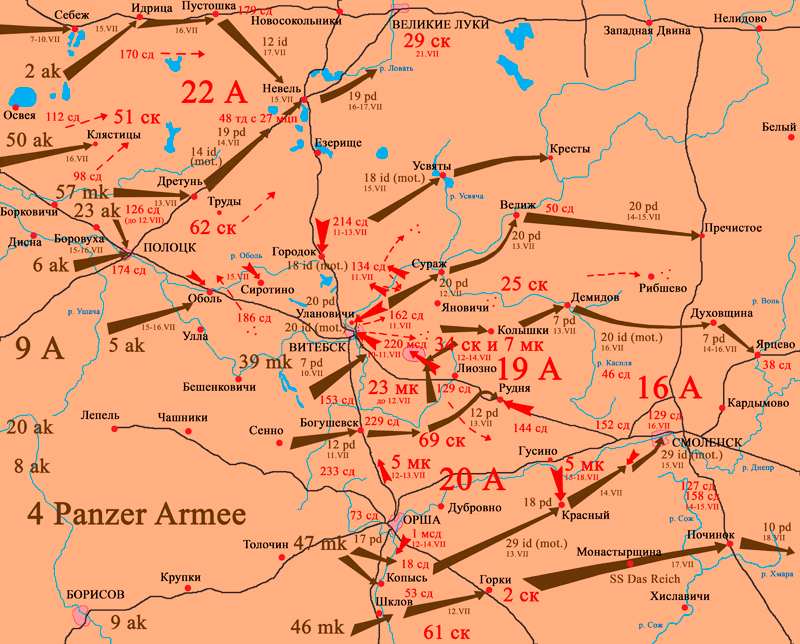
The 5th August is considered the end of the fighting in the Smolensk "pocket".
The 19th Army headquarters never managed to take control of most of the assigned formations near Vitebsk, and Lieutenant General I. S. Konev himself barely escaped death or capture. In early August, the 19th Army received new divisions and a new defensive sector. On 11 September, I. S. Konev was promoted to Colonel General, and on 12 September he was appointed Commander of the Western Front forces.
The 16th and 20th Armies, which also fought in the Smolensk "pocket", were similarly defeated, with only remnants of formations crossing the Dnieper and Vop' Rivers.
According to Army Group Centre's data, from 10 July, in the battles for Polotsk, Vitebsk, Orsha, Mogilev, and Smolensk, 310,000 prisoners were taken, along with over 3,000 tanks and approximately the same number of guns.
However, for the German forces, the Battle of Smolensk was not without cost. General Field Marshal F. von Bock described his impressions from a visit on 3 August to the 8th and 5th Army Corps: both corps had suffered significant losses, especially among officers, but "were proud of their combat achievements."
Overall, the official losses of Army Group Centre from 22 June to 1 August amounted to 74,500 personnel (though, despite German meticulousness, reliable data for Wehrmacht losses in the Battle of Smolensk, broken down into irrecoverable and medical casualties, does not exist, so it is difficult to determine what exactly is meant here).
* * * * *
The battle for Smolensk in many ways resembled the Bialystok-Minsk battle (unsurprisingly, since it involved the same RKKA of 1941). As on 22 June, the German offensive from Vitebsk towards Smolensk and across the Dnieper on 10-12 July came as an unpleasant surprise for the Soviet command.
As on 22 June, the Soviet troops were numerous (quite sufficient for defense, especially given that the enemy began its offensive with mobile formations alone, without waiting for infantry divisions). Modern tanks and excellent artillery were still available. Yet the troops were constantly in the wrong place doing the wrong things.
First and foremost, there was a lack of strategic coherence at Soviet High Command level: as before the war, no assumptions were made about possible enemy actions, nor were any preparations evident. Meanwhile, the German command continued to "play white" (maintaining strategic initiative), while Soviet military-political leadership remained under the illusion that the early defeats were mere "accidents."
A characteristic of both battles was very weak leadership at the formation and operational level. Soviet commanders proved unable to match German generals. Willpower and self-sacrifice coexisted with collapse and rout under minimal enemy pressure.
It seems the Wehrmacht and the RKKA were fighting in different dimensions, and Soviet activity did not hinder German achievement of operational goals. Soviet soldiers sometimes displayed extraordinary heroism, salvaging equipment only to destroy it later to prevent its capture. Meanwhile, the fate of the battle was often being decided elsewhere. Against Soviet heroism and tenacity (where it existed), the German army countered with professionalism and the coordinated efficiency of its military machine, operational skill overcoming Soviet commanders' determination.
The main difference between Smolensk and the Border Battles was that the front's main operational reserves (two combat-capable mechanized corps) had been lost before the Smolensk fighting, during the Lepel counterattack. Thus, there was nothing to counter German breakthroughs on 11-12 July. At Grodno and Lepel alike, Soviet command decisions were made "not on the basis of real situation analysis and sound calculations, but on intuition and a drive for activity without considering the troops' actual capabilities" (as G. K. Zhukov wrote in his memoirs on Directive No. 3). As a result, the Soviet side entered decisive battles again without reserves.
Soviet military-political leadership was, however, highly skilled at preparing and accumulating reserves. In place of the 7th Mechanized Corps lost in the offensive, the 23rd Mechanized Corps was scheduled to arrive southeast of Vitebsk by early July, but circumstances soon scattered its units in different directions, leaving only the 220th Motorized Division to bear the brunt of the Vitebsk battles.
The seemingly unstoppable advance of 4th Panzer Army formations encountered 16th Army units transferred from Ukraine near Smolensk.
The 10th Panzer Division, which broke deep into the Soviet rear near Yelnya, faced troops of the Third Strategic Echelon.
However, strategic defense is not limited to preparing reserves. True strategic defense was not evident in Soviet actions, and thus in critical moments operational reserves were lacking.
The loss of Vitebsk had the gravest consequences-it created a breach in the northern flank of the Western Front even before the Dnieper was crossed. Soviet forces now had to attempt recapture of this strategic point, while the German 39th Motorized Corps began extending the "northern pincer" to form the new Smolensk "cauldron." The 20th and 7th Panzer Divisions easily dislodged and scattered the Soviet 25th Rifle Corps (which had been ordered to attack but was forced to defend, ending up in a completely unsuitable formation) and reached the operational rear of the Western Front.
South of Orsha, Guderian's 2nd Panzer Group used two motorized corps to break through the poorly prepared defenses of less than two divisions, ensuring success.
Thus, while Soviet forces were conducting active offensives towards Vitebsk, German mobile formations were already near Smolensk. Day by day, Soviet command threw increasingly depleted tank and rifle units at Vitebsk, while enemy motor-mechanized forces were operating on their supply lines. On 14 July, a battery of Katyusha rocket artillery arrived at Orsha-but by then Orsha had turned from a Western Front fortress into the “bottom“ of a new giant encirclement.
Formally, Soviet troops near Vitebsk were sufficient (even though 19th Army had not yet fully concentrated). It was also reinforced with the battered but still combat-capable 7th Mechanized Corps. In reality, Vitebsk held only scattered formations with no coordination or unified command. No one was truly capable of conducting an offensive on Vitebsk.
More importantly, as with the Grodno counterattack, retaking Vitebsk at a certain stage no longer mattered. Once again, the Soviet command's “reflexive“ reaction played into enemy hands.
It seems the change of Western Front command did little to resolve the informational chaos. Entire divisions were lost (the mythical “128th Rifle Division in Vitebsk“ is noteworthy );
corps HQs were shuffled (e.g. the 61st and 20th). The critical Mogilev sector was assigned to 13th Army HQ, only just escaped encirclement, having lost many officers and its codes (details in the next chapter). 19th Army HQ, newly arrived from Ukraine, was immediately assigned the Vitebsk sector.
);
corps HQs were shuffled (e.g. the 61st and 20th). The critical Mogilev sector was assigned to 13th Army HQ, only just escaped encirclement, having lost many officers and its codes (details in the next chapter). 19th Army HQ, newly arrived from Ukraine, was immediately assigned the Vitebsk sector.
A characteristic episode was described by A. I. Eremenko: at the highest level, no one knew what to do when German forces attacked an incompletely arrived army whose HQ lacked communication with most units but already held a defensive sector.
On 12 July, the 19th Army headquarters received an order to regroup, relocating the concentration area of newly arriving units further east.
In his report to Stavka, Marshal S. K. Timoshenko explained:
"In order not to engage the concentrating units of the 19th Army piecemeal, I am moving the concentration areas of the 127th, 129th, 38th, and 158th Rifle Divisions beyond the Dnieper and Sot' rivers [so in the text, actually either the Vop' or Sozh - author] in the area of Yartsevo, Smolensk."
The 19th Army HQ moved to Kardymovo station (or Kurdymovo, 8 km east of Kardymovo, slightly closer to Smolensk). Unloading of arriving divisions was moved east: the 158th and 127th Divisions southeast of Smolensk (Ryabtsevo station area, advancing towards Grinevo, beyond the Sozh River); the 38th Rifle Division to Yartsevo (beyond the Vop' River).
The 129th Rifle Division was ordered to withdraw and concentrate near Kholm and Opolye, covering the northern approach to Smolensk.
The HQs of the 34th Rifle Corps and 7th and 23rd Mechanized Corps also moved east.
The Western Front evening summary described this as:
"Misunderstanding the requirement to relocate concentrations on the night of 14 July, the army decided to withdraw units to the concentration area, leaving only covering forces. Units that had not completed concentration, as well as HQ, were relocated to the Smolensk area. This decision was cancelled."
I. S. Konev later recalled:
"I reported to S. K. Timoshenko on the situation near Vitebsk and returned to 19th Army HQ near Rudnya. Upon arrival, I found that the Front HQ had ordered the 19th Army HQ to redeploy. The HQ had been moved to Kardymovo station east of Smolensk.
Chief of Staff Rubtsov had already left with operations, reconnaissance, and signals departments; only rear staff and some officers remained in Rudnya.
I decided to visit the 34th Corps. On the way I met A. I. Eremenko, Deputy Commander of the Western Front, in the forest. He said he had been to the 34th Corps and was dissatisfied with Corps Commander Khmelnitsky's actions.
In a harsh tone, Eremenko unjustifiably accused me of failing to personally stop the enemy, who was advancing on Smolensk, bypassing Vitebsk to the northwest and Orsha at the same time.
The conversation was unpleasant. I replied that if he believed I needed to personally lead an attack, I had no objections, but right now it was more important to assume control over the arriving units. Front HQ interference was entirely inappropriate; relocating HQ without my knowledge was unacceptable.
Despite these unpleasant talks, we eventually found common ground. Eremenko left for Front HQ, and I continued to Khmelnitsky's Corps…"
A. I. Eremenko described these events:
"At that time I arrived at 19th Army HQ, located in the forest north of Rudnya, and found there Lieutenant General I. S. Konev, Military Council member Divisional Commissar I. P. Sheklanov, and Chief of Staff Major General P. N. Rubtsov.
The Army Commander and I visited forward units. He went towards Vitebsk, I to the right flank near Surazh, where one rifle division [134th] was operating. There was no contact with it, as it was fighting encircled. Near Kolyshki, I encountered rifle and artillery regiments of another division [162nd], ordered to move to Surazh. However, the Germans had already captured it, advanced to Velizh, and occupied it. The 19th Army's right flank was exposed.
I ordered the rifle and artillery regiments to hold the Ponizovye-Kolyshki line to prevent enemy flanking attacks and returned to HQ to check on troop arrivals.
General Rubtsov reported an order designating a new deployment line for the 19th Army, 50-60 km further east. This order created chaos, as some divisions were already in combat and now had to be withdrawn.
I was dismayed by this inexplicable decision - yielding 50-60 km of territory without reason.
With no phone contact to Front HQ, I immediately left. Before sunrise, I was at Marshal Timoshenko's. He had just gone to bed, but I woke him and reported the strange order.
'Andrei Ivanovich,' said Timoshenko, 'apparently this was a regrettable misunderstanding. Please return immediately and restore the situation.'
I left for Rudnya at once…
Movements of HQs and some troops mainly followed the Vitebsk-Smolensk highway, making them easy to intercept.
However, we failed to intercept the 34th Rifle Corps HQ. Its commander withdrew 60 km with HQ, leaving his units near Vitebsk, as ordered.
We chose our forward command post 1 km northwest of Rudnya, 150 m from the Vitebsk highway.
The 19th Army operations group was positioned 18-19 km towards Smolensk."
"…As the sun set near the horizon, German tanks appeared near Rudnya, advancing along the road towards the city near my HQ. Hearing gunfire unlike field artillery, I sent a liaison officer ahead by car to investigate. 3 km from HQ, at a road bend, he encountered a German tank column, with three Nazi officers leading in a staff car.
The liaison officer, quick-witted, jumped out, threw a hand grenade at the German car, then ran back through tall rye to warn us. The tanks paused at the destroyed car, then resumed towards Rudnya.
By the time the officer reached us, the enemy tanks had arrived in our area, firing along the road and shoulders. German aircraft continually bombed and strafed ahead of the tanks.
We were concealed in dense bushes in a ravine, away from the road. Vehicles and men were well hidden in the rye, and the HQ exit to the highway was far off.
When tanks reached within 500 m of Rudnya, two military cars emerged from the city, unaware of the danger. Spotting the tanks, the passengers jumped out and ran to an AT battery on the city's outskirts. Several guns opened fire, stopping the lead tank. The following tanks turned to engage the battery, which continued firing, delaying them.
The men who had organized the artillery response returned to their cars and drove off-road.
Later it turned out that those cars carried 19th Army Commander Lieutenant General I. S. Konev and Political Department Chief Brigade Commissar A. M. Shustip, who was wounded in this battle. They had been heading to forward units, planning to visit our HQ en route. On leaving the city and unexpectedly encountering the tanks, Konev quickly organized the defense.
Near Rudnya, the lead tanks again paused, firing at the station and city. The following motorized infantry column deployed, with MGs opening fire. German assault troops advanced towards us.
Only one option remained - withdrawal north. Ahead lay 150-200 m of open ground. I told driver Demyanov to make sharp turns into the rye. With me were Khirnykh and Parkhomenko; others also prepared to retreat, some by car, motorcycle, or on foot.
The Germans never imagined the Deputy Front Commander's HQ was right under their noses. Their tanks and MGs were not aimed at us, and our maneuver succeeded. A few MG bursts followed, but all escaped. General Konev, believing I had been killed, reported my death to Front HQ…"
Eremenko also reported seeing Konev's apparent death during the AT-tank skirmish. Konev later recalled:
"By the Vitebsk-Rudnya highway, I saw an abandoned 45-mm AT gun with some shells, manned by a lone artilleryman. We pulled it onto the road for a better position. While doing this, my adjutant Colonel Chernyshov, observing with binoculars, suddenly reported: 'Comrade Commander, German tanks are emerging from the forest onto the highway!'
I looked - indeed, tanks with crosses and swastikas. I stepped behind the gunner, ordered him to fire. We hit the lead tank - smoke billowed. The Germans recovered quickly, maneuvering their tanks. We had to retreat, initially by car, but it got stuck in a vegetable garden near Rudnya. We abandoned it, running between houses under fire.
My Political Chief was wounded in the arm. We jumped a fence, up a ravine, and found a fuel truck on a rise. Another car arrived; we loaded the wounded and sent him under fire to HQ. I rode the fuel truck over the rise, found another car, and by evening reached my HQ at Kardymovo station. Upon arrival, they told me: 'We received a report that you had been killed… General Eremenko reported seeing German tanks firing directly at you.'
My appearance was a total surprise to everyone…"
* * * * *
In 1941, the Red Army faced a catastrophic shortage of competent operational commanders (corps, army, and front level). Thus, local successes changed nothing in the deadly overall picture: a battle lost at the High Command and front level could not be won at regimental or divisional level.
On 30 July 1941, RKKA Chief of General Staff G. K. Zhukov was dismissed-who else bore responsibility for the war's disastrous start? Yet his removal changed little. Many formations that survived the events on the Western Front in the summer of 1941 perished just a few months later, in October 1941, in the Vyazma “pocket.”
The Vyazma catastrophe surpassed in scale even the defeats near Bialystok and Minsk, and near Kiev.
After the disastrous start of the Battle of Moscow, Zhukov was recalled to the Western Front. His name is linked to the first Soviet victory over the Wehrmacht - the successful counteroffensive near Moscow.
But that victory was followed by the failed Vyazma offensive, new disasters in summer 1942, and the retreat to Stalingrad.
Characteristic was Lt. Gen. Konev's behavior under Vitebsk - he clearly acted as a divisional commander, at best a corps commander, not an army commander. Similarly, Deputy Supreme Commander for Western Direction Lt. Gen. Eremenko, tasked with coordinating three armies, acted at corps or army command level, not as an army group coordinator.
A report to L. Z. Mekhlis on the 117th Rifle Division's defeat near Zhlobin on 6 July 1941 stated:
"The battle showed that soldiers, junior commanders, and platoon commanders fought stubbornly. Company and battery commanders led by personal example, going ahead and rallying their units. Battalion and divisional commanders were confused, fussed about, and failed to control their units in battle. Regimental commanders lacked experience, lost control, failed to organize combat or assign clear tasks to supporting artillery and tanks. The division commander could not determine his place in battle, moving between battalions without finding a true command position in the complex situation…"
Apparently, in complex situations, commanders acted at the "level" closest to their personal experience.
* * * * *
However, the German breakthrough to Smolensk did not end the battle. On the contrary, this breakthrough became only the "opening act" of a new battle on the Soviet-German front.
Modern historian A. Isaev writes in Blitzkrieg Halted (2010):
"By the 20s of July 1941 near Smolensk, the situation resembled early July. German panzer groups had advanced far beyond the Dnieper line and were operating detached from the 9th and 2nd Armies' infantry. Several Soviet operational groups were created with the maximum objective of defeating these forward enemy mechanized units. This would allow the 16th and 20th Armies to avoid encirclement near Smolensk…"
However, Isaev, following Soviet command thinking, greatly misjudges the situation. In early July, much of the German mobile forces were still tied down by Soviet troops west of Minsk, and only individual divisions advanced separately without forming a continuous front. By the 20s of July, entire panzer groups advanced in full strength. Most had already assumed defensive positions that Soviet forces would now have to assault. Meanwhile, German infantry divisions had crossed the Dnieper; some were already relieving panzer forces and entering the battle for Smolensk.
There was no gap between German echelons. On the contrary, new infantry divisions arrived daily, further "thickening" the encirclement walls. German forces advanced wave after wave:
• 11-12 July: 39th, 47th, and 46th Motorized Corps broke through to Smolensk;
• From 16 July: 5th and 9th Army Corps caught up;
• In the 20s of July: 20th and 8th Corps reached Smolensk.
By 24 July, Dukhovshchina, designated by Soviet command as an operational goal, was defended not merely by elements of the 7th Panzer Division but by the main forces of 39th Motorized Corps, including the 7th and 12th Panzer Divisions and the 900th Brigade, with the 20th Motorized and 129th Infantry Divisions in support.
Thus, the apparently risky plan to advance east with mobile units alone worked perfectly. On 19 July, German General Staff Chief Franz Halder noted in his diary:
"A captured Russian order shows their command aims to cut off our panzer units from infantry with flank counterattacks. Theoretically a good idea, but practically only possible with numerical and operational command superiority. Against our troops, I think this idea is inapplicable…"
As for Soviet command, once again there was a complete lack of coordination between Strategic Echelons, this time between the Second and Third.
Even the enemy's breakthrough to Smolensk on 15-16 July did not affect Third Strategic Echelon actions (just as the Western Front's encirclement by late June did not affect Second Echelon deployment). Only by the 20s of July did Soviet command consider supporting the bleeding Western Front forces near Smolensk with Third Echelon troops.
On the one hand, concentration of the Third Strategic Echelon (Reserve Armies Front) gave new impetus to what seemed a lost battle. This applies to Operational Groups' offensives of 23-24 July, and even more so to later actions by the Western (Dukhovshchina operation, August 1941) and Reserve Fronts (Yelnya operation).
On the other hand, while encircled armies near Smolensk bled heavily (as the Western Front had in the Bialystok and Minsk "pockets"), and K. K. Rokossovsky near Yartsevo tried to gather any troops to break through to Smolensk and regain control of the Moscow highway, 24th Army nearby continued "perfecting its defenses."
On 19 July, it entered combat (19th Rifle Division near Yelnya, 107th near Dorogobuzh), ending its "reserve" status. But the critical time for a deep offensive, when the enemy was most vulnerable, had passed.
Notably, 19 July saw an attempt to coordinate Second and Third Echelon actions: Marshal S. K. Timoshenko, Supreme Commander of Western Direction forces, was subordinated the Reserve Armies Front. That day, General Staff issued its first directive to involve Reserve Front troops in the Smolensk battle.
Yet in practice, the RKKA continued to act as disconnected echelons.
However, Stalin could not entrust Timoshenko with "the most sacred" - the last reserves on the Moscow axis.
After fair criticism of High Command's mishandling of two mechanized corps in the Lepel counterattack-how could those same generals, already proven unable to fight Germans as equals, be trusted again with the best-prepared forces? They had proven capable only of squandering any troops, no matter how well armed or trained.
A new aspect of the Smolensk battle was that several armies (24th, 29th, 30th) were commanded by NKVD generals. Combined with the condemnation and execution of Western Front generals at the same time, this showed Stalin's enormous confusion and his reliance on loyal but unprofessional people-mere executors, not commanders.
But could they oppose professional German generals effectively?
Could they manage their forces competently, other than simply "throwing them into battle" wherever and however ordered?
* * * * *
It should be noted that German command performance at Smolensk was not particularly brilliant either, except that during the Smolensk battle their underestimation of the USSR was even greater than at Bialystok-Minsk.
During the creation and liquidation of the Bialystok and Minsk "pockets," Germans encountered unusual resistance. In the Smolensk battle, a successful (indeed "audacious" in the best sense) breakthrough was followed by failure to seal the Smolensk encirclement.
The enemy was unprepared for such fierce resistance from forces already encircled and "seemingly defeated". Though it was probably not a matter of "Russian character" per se, but rather the numbers and armament of the encircled forces (each time the main forces of the Western Front).
Under these conditions, it became clear that "German command lacked the strategic level of war leadership": when facing such a strong and prepared enemy, it was unclear what needed to be done to win the war. This is seen in the debate between Hoth and Guderian regarding further actions of 46th Motorized Corps after Yelnya's capture, and Hoth's opinion that Smolensk's capture by the 29th Motorized Division had no operational significance is noteworthy.
In his memoirs, Commander of the 3rd Panzer Group H. Hoth used rather strong language when discussing the closure of the "pocket" near Smolensk:
"The right-flank XLVI Panzer Corps of the 2nd Panzer Group was repelling fierce enemy counterattacks near Yelnya. Both panzer divisions of the left-flank XLVII Panzer Corps, under enemy pressure, turned their front northward in the area of the highway. South of the Dnieper (along the Smolensk-Orsha line), parts of the corps became entangled in senseless and bloody battles, which were operationally completely unnecessary.
The intervention of the 4th Panzer Army commander, who sought to secure the flanks as much as possible, again proved to be an obstacle and diverted forces from the decisive sector of the battle east of Smolensk.
On 16 July, the 29th Motorized Division broke into Smolensk. This was a success that brought the battle-hardened division well-deserved recognition, but it had no operational significance [emphasis mine - author], for contact with the 3rd Panzer Group was never established, and there remained a gap in the encirclement between Smolensk and Yartsevo.
Even after the XLVII Panzer Corps was freed from the fighting east of Orsha, the 2nd Panzer Group still failed to establish contact with the 3rd Panzer Group along the highway, allowing some Russian units to escape towards Dorogobuzh.
The commander of the 2nd Panzer Group apparently believed that holding the heights near Yelnya was of greater importance for the advance eastward than completing the encirclement of enemy forces within his sector of operations."
Moreover, Soviet command found a Wehrmacht "weak spot": in battles for important or "symbolic" localities, the enemy lost its advantages, especially in maneuver warfare.
Perhaps that is why this new major German success in the East, unlike the Bialystok-Minsk battle, did not elicit euphoria. German forces focused on breaking through eastward and encircling Soviet forces near Smolensk, but lacked sufficient strength not only to reliably seal the "cauldron" but also to secure their flanks. On 20 July 1941, German General Staff Chief F. Halder wrote in his diary:
"…The enemy managed to break the encirclement near Nevel… The situation is discouraging. The units breaking out will move towards Velikiye Luki, further worsening the situation of the 19th Panzer Division, already in serious difficulties today. Overall, the situation has sharply deteriorated on several sectors of Army Group Centre's front…"
By 21 July, German forces had been driven out of Velikiye Luki:
"…This is very unfavorable. Significant enemy forces <facing German 16th Army> can now escape the threat of encirclement…"
Halder also noted Soviet successes near Propoysk (only rectified by committing the 4th Panzer Division) and a sharp worsening of the situation west of Smolensk.
On 22 July, Halder again commented on Army Group Centre's northern flank:
"After our forces failed to encircle the enemy near Nevel and had to abandon Velikiye Luki, the chances of achieving a major success that would give us decisive superiority have greatly decreased…"
Given the large Soviet grouping active near Gomel and Roslavl, on 23 July Halder recorded:
"On the Smolensk bulge, enemy pressure from the southeast and northeast should be expected soon…"
Even at the spearhead of their main offensive, German forces, instead of gaining operational freedom, encountered the Third Strategic Echelon - the Reserve Armies Front. After taking Yelnya, 46th Motorized Corps was supposed to advance to Dorogobuzh but was pinned down by 24th Army attacks. Yelnya became a "typical example of positional warfare" as understood in WWI - bitter fighting for a small town that became an important operational point. Reinforcing 46th Motorized Corps proved impossible: Soviet activity on the southern face of the Smolensk "cauldron" tied down 47th Motorized Corps, while 24th Motorized Corps divisions were pinned on the Bykhov-Krichev front.
On 20 July 1941, Halder also wrote:
"The ferocity of battles fought by our mobile formations, operating in separate groups, the tardy arrival of infantry divisions slowly advancing from the west, the constraints of bad roads, not to mention the extreme fatigue of troops marching and fighting continuously since the war's start - all this has caused a certain decline in morale among our leadership. This is particularly evident in the completely depressed mood of the Commander-in-Chief <Brauchitsch>."
On the evening of 23 July, a meeting was held at which Hitler presented his vision for future operations against the USSR:
"Infantry units are concentrated in the central sector. Panzer units are deployed divergently,"
Halder recorded. The plan was to turn Hoth's 3rd Panzer Group north to support Army Group North and Guderian's 2nd Panzer Group south to link with Army Group South.
Later, due to continuous Soviet attacks on the Smolensk axis, the order for Army Group Centre to continue advancing on Moscow with infantry alone was amended. On 30 July, a new OKW Directive No. 34 ordered Army Group Centre to go on the defensive.
All these enemy problems were small but real glimmers of hope amidst the seemingly hopeless events of 1941. After many trials and years of bloody struggle, these "glimmers of hope" were destined to become the dawn of Great Victory.