


"- Where did the 1000 tanks of the 6th Mechanized Corps go? How is this to be explained, Stirlitz? - Indeed, this is hard to explain, Gruppenfuhrer. Almost impossible. In your place I would not believe a single one of my explanations…"
(a paraphrase from the film "Seventeen Moments of Spring")
The events on the Western Front in June-July 1941 are so complex that after their description in general terms, certain knots require separate, closer examination.
Therefore, already after the completion of the "main body" of the project (5 chapters), I turned to the events around the Defense of Polotsk and the battle for Nevel and Velikiye Luki (Chapter 6), then to the events in the area of Lida (Chapter 7).
Now it seems important to me to examine in more detail the course of combat operations in the area of Slonim and Baranovichi, as key to the defeat of the troops of the Western Front in the Belostok salient. Moreover, it is important to me to examine the actions of the Soviet side in particular, because it is still not fully clear who organized the defense of perhaps the most strategically important point in Belarus, and how.
Polish map of the Zelva, Slonim area, 1933
It turned out that as a result of the crushing blow of the Wehrmacht, the Soviet 4th Army was defeated on the very first day of the war. By June 23 (a sad record!) the army as a single organism ceased to exist and turned into a collection of scattered detachments. This was greatly facilitated by the initial disposition of its units and formations (see Table 8-1).
| 4th Army (Major General A. A. Korobkov, chief of staff Colonel L. M. Sandalov; headquarters - Kobrin) | 28th Rifle Corps (Major General V. S. Popov, Brest → Zhabinka) | 6th Rifle Division (Colonel M. A. Popsuy-Shapko, Brest) • 84th RR, 333rd RR and 131st LAR (Brest Fortress) 42nd Rifle Division (Major General I. S. Lazarenko, Brest) • 44th RR, 455th RR and 17th HAR (Brest Fortress) 447th CAR (Brest, Northern Townlet)* 455th CAR (Pinsk)** |
| 14th Mechanized Corps (Major General S. I. Oborin, Kobrin) |
22nd Tank Division (Major General V. P. Puganov, Brest, Southern Townlet)
• 43rd and 44th TR, 22nd MRR, 22nd HAR 30th Tank Division (Colonel S. I. Bogdanov, near Pruzhany)
• 60th and 61st TR, 30th MRR, 30th HAR 205th Motorized Division (Colonel F. F. Kudyurov, Bereza-Kartuzskaya)
• 721st and 733rd MRR, 253rd TR, 672nd AR 20th Motorcycle Regiment (Drogichin) |
|
| At the disposal of the army headquarters |
49th Rifle Division (Colonel K. F. Vasilyev, Vysokoye) Brest Fortified Region (62nd) (Major General M. I. Puzyrev, Brest → Vysokoye) 75th Rifle Division (Major General S. I. Nedvigin, Malorita) 120th High-Power Howitzer Artillery Regiment of the Reserve of the High Command (Kossovo → Obuz-Lesna) |
* Part of the regiment was at the training ground in the area of Chemery (east of Kamenets, 20 km north of Brest), where it came under the blow of the advancing German tank divisions. And from the Northern Townlet of Brest the regiment managed to bring out 19 guns (out of the authorized 36).
** Part of the regiment was at the training ground south of Traugutovo (in the area of the Brest Southern Townlet) on scheduled firing and also came under the first blow; the regiment itself from Pinsk was withdrawn to the east and did not participate in the June battles in the zone of the 4th Army.
The city of Brest was located right on the Soviet-German border; in this area three infantry divisions of the German 12th Army Corps (the 31st, 45th and 34th) advanced with the support of a large number of heavy-caliber artillery.
The commander of the 28th Rifle Corps, Major General V. S. Popov, on July 8 submitted a report to the commander of the 4th Army, Major General A. A. Korobkov: "…At 4.15 on 22/VI 1941 the enemy from shortened distances suddenly opened concentrated rapid artillery fire (no fewer than 4-5 artillery regiments) on the areas - the fortress, the Northern Townlet and the Southern Townlet… In the very first period of the artillery shelling the bridges leading out of the fortress (across the arm of the Mukhavets River) were destroyed. The structures and warehouses of the fortress, the military townlets, as well as the area of the Brest railway station were immediately engulfed in fire, and the fire spread rapidly due to the continuing intensive bombardment. All communication was immediately disrupted. In these conditions the units of the Brest garrison began to rise on alarm, suffering heavy losses in personnel and material.
The orderly assembly and deployment of the corps units envisaged by the "red packet" were disrupted <here and further in the cited documents the emphasis is mine>… The garrison of the fortress was by artillery fire and fire cut into separate groups of people, one part of which sought shelter from the shelling, another - through the flames of fires and the continuous explosions of shells strove for the exits from the fortress. As a result it was possible to bring out the scattered subunits of the 333rd and 125th RR, as well as individual groups of the 44th, 455th and 84th RR. In the end part of the garrison of the fortress suffered losses in killed, wounded and missing; the warehouses and most of the material of the garrison of the fortress were destroyed. The overwhelming majority of the families of the command staff remained in the city of Brest and in the fortress. In total, of the units that were in the fortress: 5 battalions of the 6th RD and 2 battalions of the 42nd RD with special subunits, presumably up to 50% were brought out..."
The headquarters of the 4th Army practically immediately lost control of its troops. L. M. Sandalov (in 1941 - colonel, chief of staff of the 4th Army, one of the few who survived those events, ended the war with the rank of colonel general) after the war wrote memoirs and in parallel prepared a military-historical study (which, unlike the memoirs, in Soviet times had the classification "For Official Use"), where he frankly described the catastrophe of the 4th Army on the first day of the war:
"In the period from 6 to 7 o'clock German aviation by its strikes destroyed the military townlet in Kobrin, and the headquarters of the 4th Army by 10 o'clock moved to Bukhovichi <about 10 km east of Kobrin> and began to organize the control of troops from the alternate command post.
…By 10 o'clock in the morning a difficult situation had developed in the zone of the army, but no one could truly realize and assess it. Only by 12 o'clock in the afternoon of June 22 did several reports on the combat operations of the troops arrive at the address of the army command. But even from these reports it was not possible to assess the situation that had developed.
From the reports of the officers of the army headquarters who had returned from the divisions and the reports of liaison delegates the situation began to become somewhat clearer. It became obvious that to drive the enemy out of Brest was beyond the power not only of the already combat-ineffective 6th Rifle Division, but also of the entire 28th Rifle Corps.
Having received data on the situation, the army commander at about 11:30 gave the troops the following instructions: the 28th Rifle Corps was not to allow the further advance of the enemy toward Zhabinka; the 14th Mechanized Corps, consisting of the 22nd and 30th Tank Divisions, concentrated in the area of Vidoml, Zhabinka, was to attack the enemy in the Brest direction together with the 28th Rifle Corps and the 10th Mixed Aviation Division and restore the situation.
From the instructions given by the army commander it is evident that the situation for him and the army headquarters continued to remain insufficiently clear, since the troops of the army were given impossible tasks.
…Since from the command post of the army in Bukhovichi it was not possible to establish wire communication with the district and the corps, in the period from 16 to 17 o'clock the movement of the army headquarters from Bukhovichi to Zaprudy began <this is already almost 25 km east of Kobrin, almost halfway to Bereza-Kartuzskaya>, where by this time an organized new communications center of the army had begun to work.
During the move the army headquarters suffered great damage from the strikes of German aviation: the staff buses and two radio stations intended for work with the district and the aviation division were destroyed, many officers of the headquarters were killed and wounded.
To report on the situation in the zone of the army and to obtain information on the general situation and instructions on further actions, at about 16 o'clock the chief of the operational section of the operational department of the army headquarters, Captain V. S. Makarov, was sent to the auxiliary control point (ACP) of the district headquarters in Obuz-Lesna. At the same time the chief of communications of the army, Colonel A. N. Litvinenko, managed to establish communication by Morse apparatus with Minsk, and the chief of staff of the army, Colonel L. M. Sandalov, got the opportunity to talk with the chief of staff of the front, Major General V. E. Klimovskikh.
After the report on the situation, the chief of staff of the army received instructions to take all measures to restore the situation. Major General Klimovskikh also ordered to contact the headquarters of the 10th Army, to report to the front headquarters the situation in its zone, and to inform the commander of the 10th Army, Major General K. D. Golubev, of the resubordination to him of the 49th Rifle Division, since the headquarters of the 13th Army would not arrive at the Belsk sector of the front. The chief of staff of the front added that a representative of the front command would arrive at the headquarters of the 4th Army. During the negotiations it turned out that nothing was known at the front headquarters about the enemy and about the position of the 10th and 3rd Armies…"
The Soviet units (remnants) of the 28th Corps and the 22nd Tank Division that had retreated from Brest tried to cling to the defensive line of Zhabinka, Khvedkovichi (25 km east of Brest), but were driven from their positions and began to retreat to Kobrin (another 25 km east).
In the combat journal (CJ) of the German 3rd Tank Division its advance south of Brest with the exit to the Warsaw highway on June 22 is described as follows:
16:50 (here and further Berlin time) air reconnaissance: the bridge over the Mukhavets River north of Bulkovo is ablaze, the bridge in the area of Zhabinka is still intact. Combat group Korvin reached Franopol, overcoming the stubborn resistance of the enemy.
18:30 Combat group Korvin occupied Franopol, capturing a large number of guns.
In the area of Bulkovo German sappers began to build a bridge with a carrying capacity of 16 tons. Only tanks with underwater travel capability were able at 22:00 to force the Mukhavets River in this area and break through to Kobrin without substantial resistance of the enemy. The 3rd Motorcycle Battalion was able to break through to Zhabinka and capture the bridges in this area.
About June 23: "08:45. As a result of the assault the forward subunits managed to enter Kobrin. Several tanks were destroyed, one bridge was destroyed and another is in an undamaged state".
At 9:30 on June 23 the commander of the 4th Army, Major General A. A. Korobkov, reported to the front commander, General of the Army D. G. Pavlov: "The poorly controlled units, frightened by attacks from low-level flights of enemy aviation, are retreating in disorder, not representing a force capable of holding back the enemy. Popov <commander of the 28th Corps> and Oborin <commander of the 14th Corps> display instability, prematurely withdraw units and especially headquarters".
We know that the enemy immediately seized air supremacy, which played an enormous role in the defeat of the Soviet troops. As a cause, one should cite the well-known information about the destruction of the aviation of the Western Front, in particular, the 10th Mixed Aviation Division attached to the 4th Army. Less discussed was what happened to the air defense in the zone of responsibility of the 4th Army. Modern researchers have identified a number of details that contributed to the complete supremacy of German aviation in the air and led to the defenselessness of the Soviet units.
In the zone of responsibility of the 4th Army, as early as the spring of 1941, the formation of the Kobrin Brigade Air Defense Area (commander - Major General I. F. Nikitin) had begun, consisting of 6 anti-aircraft artillery battalions. Three of them, apparently, were still only being formed at the training ground in Krupki east of Minsk, while the other three were located:
- the 218th AAD - in Brest, with the beginning of the war suffered losses and already at noon on June 22 together with the headquarters of the brigade area moved to the area of Bereza-Kartuzskaya (here by fire of small-caliber anti-aircraft artillery it shot down the first German aircraft), then departed to Pinsk and further to the rear;
- the 298th AAD - pre-war disposition Cheremkha (south of Gajnowka, on the southern face of the Belostok salient), on June 21 transferred to Kobrin;
- the 301st AAD - from Kobrin before the war moved to the area southwest of Baranovichi to cover the Obuz-Lesna district training ground, and on June 22 departed to Minsk.
All pre-war movements of the air defense units took place with the knowledge and by order of the chief of air defense of the Western Front, Major General S. S. Sazonov; there is clearly a certain logic in them. The entire air defense system in the ZapOVO was being reformatted. At the same time the air defense units were being rearmed with modern 85-mm guns, very good, but not mastered and having a limited number of shells; the air defense commanders on the first day of the war were preoccupied with saving the material for which they were responsible with their heads.
And already on June 23 or 24 the commander of the Kobrin brigade area, Major General I. F. Nikitin, found himself at the headquarters of the 20th Army (in the area of Smolensk? Orsha? either he had retreated east from the area of Kobrin, or was returning from leave to his unit); in July 1941 he took part in the Smolensk Battle.
Additional information: in January 1941, Hero of the Soviet Union Colonel General G. M. Shtern was appointed chief of the Main Directorate of Air Defense of the People's Commissariat of Defense of the USSR. And on May 15 a German transport aircraft, not intercepted by the air defense forces, made an unauthorized flight along the route Belostok-Minsk-Smolensk-Moscow, where it landed. This led to a wave of arrests among the leaders of air defense and the air force; G. M. Shtern himself was arrested on June 7, 1941 (accused of counter-revolutionary activity and shot on October 28, 1941); Major General S. S. Sazonov received a reprimand for this incident on June 10.
From the example of the 10th Army in Belostok it is known that the air defense troops in the first hours of the war sacredly observed the instruction not to open fire on violators of the airspace (repressive measures against those who disobeyed this order in the pre-war days are known). Here is the report of the chief of the 3rd Department of the 10th Army, Regimental Commissar S. L. Los, of July 13, on how on June 22 they began to bomb Belostok at 3.58. "…Following this they began to bomb the Belostok airfield, the communications battalion of the army, the communications center, the railway and a number of other objects. At the same time almost all the cities and small towns where the headquarters of the formations of the 10th Army were located were subjected to bombardment.
The 4th Air Defense Brigade, covering Belostok, was inactive until about 8 o'clock in the morning and did not fire a single shot at the enemy. During the investigation it turned out that the 4th Air Defense Brigade had a special order from the assistant commander of the ZapOVO for air defense not to fire at enemy aircraft until a special instruction, and this order was already countermanded by the commander of the 10th Army…"
The events in the air defense troops of the Western Front on the eve and in the first days of the war are still awaiting their researcher. For us it is important that the result was the actual disbandment of the Kobrin brigade air defense area on the very first day, and at the disposal of the troops of the 4th Army there remained only the organic means of army air defense (and even those many were at the training ground in Krupki east of Minsk, in particular, the 12th Separate Anti-Aircraft Artillery Battalion of the 28th Rifle Corps).
After the defeat of the main forces of the 4th Army in the area of Brest, for the German tank divisions, which on June 22 bypassed Brest (the 47th Motorized Corps with two tank divisions from the north and the 24th Motorized Corps with two tank divisions from the south) and aimed at a further offensive to the east, the only obstacle could be the 30th Tank Division of the 14th Mechanized Corps (disposition - area of Pruzhany) on the Brest-Slonim highway and the 205th Motorized Division of the same mechanized corps (disposition - Bereza-Kartuzskaya and environs) on the Warsaw highway (it went from Brest to Slutsk, and further, to Bobruisk); here too in the area of Bereza-Kartuzskaya there was not only an automobile but also a railway bridge over the Yaselda.
Two divisions on the defensive line of the Yaselda River, very swampy and inconvenient for forcing - that is already not bad. Why were they unable to hold back the enemy?
In the protocol of the interrogation of the front commander, General of the Army D. G. Pavlov, it was said how already in the first days of the war to the 4th Army: "…my assistant for military educational institutions Khabarov was sent with my strictest order, if necessary, to shoot any number of people, but to stop the retreat of the 4th Army and to achieve that the army headquarters took control into its hands".
In the memoirs of the chief of staff of the 4th Army, L. M. Sandalov, this was said as follows (we are talking about the evening of June 22): "…a representative of the front headquarters also arrived in Zaprudy. It turned out to be General I. N. Khabarov, before the war the assistant commander of the district for military educational institutions, and now himself not knowing his position. His outdated information about the situation and the written orders he delivered about the "destruction of the broken-through fascist bands" caused only a feeling of annoyance. But Khabarov came to us not only with this. He reported on the advance to the area of Slonim, Baranovichi of the 47th Rifle Corps. Khabarov assured that he had personally seen the first echelons of the corps headquarters and one of its rifle divisions*, following from Bobruisk. Another rifle division from Gomel was already unloading in Baranovichi*. The third, located in Slutsk*, would begin to be transported in the evening by front motor transport along the Warsaw highway to Bereza".
In the military-scientific work "Combat Operations of the Troops of the 4th Army of the Western Front in the Initial Period of the Great Patriotic War" L. M. Sandalov described this as follows:
"...at 18 o'clock <June 22> the assistant commander of the troops of the district (front) for military educational institutions (higher educational establishments), Major General I. N. Khabarov, arrived at the command post in Zaprudy. He handed to the commander of the 4th Army, Major General A. A. Korobkov, an order from the front headquarters signed by the chief of staff of the front, Major General Klimovskikh. The order said:
"To the commander of the 4th Army.
The commander of the ZapOVO ordered: to decisively destroy the broken-through and breaking-through bands, for which first of all use Oborin's corps (14th MC). In regard to actions be guided by the "red packet". Use aviation for joint attacks with the mechanized units. I draw exceptional attention to the maintenance of communication. Use radio communication, communication of the VNOS posts, delegates on aircraft directly to the district headquarters and to the nearest telegraph or telephone station. Inform every two hours. I place responsibility for this on you".
Attached to the order was an extract from Directive No. 2 of the People's Commissar of Defense of the USSR of June 22, 1941".
Directive No. 2, written in the morning of June 22 and delivered to the 4th Army at 18.00, as L. M. Sandalov wrote, completely did not correspond to the circumstances. As did the "red packet" (L. M. Sandalov described it as follows: "The army command in fact also did not take any independent decisions, apart from bringing the troops to combat readiness, in the first hours of the war. And having become convinced that the war had begun, it tried to carry out the decisions taken before the war according to the RP-4 plan, which in no way corresponded to the developing situation".)
"The army commander, it is true, tried on this question <regarding the implementation of Directive No. 2> to learn the opinion of General Khabarov, as a representative of the front headquarters, to which he received the answer: "You can see better from the situation…"
...After the drafting of the order <of the 4th Army for the counteroffensive> General Khabarov informed the army command that today Lieutenant General I. V. Boldin would fly to the 10th Army to direct the mechanized cavalry group. This group together with the 3rd Army was to deliver a blow to the enemy in the Grodno direction. At the same time the army headquarters also received information that the headquarters of the 13th Army was moving not to Belsk but to Novogrudok" <in the end the headquarters of the 13th Army arrived in Molodechno>.
Let me cite that order for the counteroffensive in full:
1. The enemy has bandit-like attacked the Soviet cities and has pushed back our units in an easterly direction.
2. The units of the 4th Army, continuing during the night a firm defense of the occupied lines, from the morning of 23.6.41 go over to the offensive bypassing Brest from the north with the task of destroying the enemy that has crossed the Western Bug River.
The blow is delivered by the 14th Mechanized Corps together with the 28th Rifle Corps and the high-speed bomber aviation regiment of the 10th Mixed Aviation Division. The 75th and 49th Rifle Divisions are to continue to hold the occupied line.
3. The 14th Mechanized Corps (22nd, 30th and 205th Motorized Divisions) from the morning of 23.6.41 is to deliver a blow from the line Krivlyany, Pilishchi, Khmelevo in the general direction of Vysokoye with the task by the end of the day of destroying the enemy east of the Western Bug River. On the right, enveloping flank have the 30th Tank Division and for the development of success and the covering of the right flank the 205th Motorized Division. The attack of the tanks is supported by the 6th High-Speed Bomber Aviation Regiment of the 10th Mixed Aviation Division.
4. The 28th Rifle Corps delivers a blow with its right flank (the 6th, 42nd Rifle Divisions and a battalion of tanks of the 205th Motorized Division) in the general direction of Brest, with the task by the end of the day of occupying Brest.
5. Begin the attack at 5.00 on 23.6.41 after a 15-minute artillery barrage.
6. Do not cross the border until a special instruction…"
The modern researcher M. Solonin in his book "June '41. The Final Diagnosis" (2013) assessed this decision for a counterattack by the forces of the already practically defeated 4th Army as follows: "Seen from today - this is complete madness; what kind of offensive could there be with the existing correlation of forces (and taking into account the real state of these forces)?"
About the support by aviation, which was mentioned in the combat order, L. M. Sandalov wrote as follows: "From the deputy chief of staff of the 10th Aviation Division summoned from Pinsk <where the headquarters of the aviation division had relocated after the crushing blow of the enemy on June 22> the army command learned that the Pinsk airfield had been subjected to repeated bombing, the runway was destroyed, the warehouse with aerial bombs was blown up and therefore with the remaining aircraft the division would not be able to take part in the combat operations of June 24".
The only reasonable decision would have been to occupy the defensive line along the Yaselda River with bridges prepared for demolition, two highway bridges and one railway bridge suitable for the passage of heavy equipment: east of Pruzhany and in Bereza-Kartuzskaya.
However, an order is an order.
The Soviet 30th Tank Division was formed on the eve of the war on the basis of a light tank brigade and at the beginning of the war had in service 189 T-26 tanks (including 22 chemical ones), 22 amphibious T-37 and T-38 tankettes and 92 armored cars. In this respect it was inferior both quantitatively and qualitatively to the German tank divisions of the 47th Motorized Corps, which it had to oppose (see Table 8-2).
| Pz.I | Pz.II | Pz.III (37 mm) | Pz.III (50 mm) | Pz.IV | Befehlspanzern* | |
| 17 PD (39 Pz.Rgt) | 12 | 44 | - | 106 | 30 | 10 |
| 18 PD (18 Pz.Rgt) | 6 | 50 | 99 | 15 | 36 | 12 |
* Command tanks, armed only with machine guns, with a dummy gun.
L. M. Sandalov recalled a conversation with the division commander, Colonel S. I. Bogdanov, immediately before the war, on June 21, 1941: "…I with Bogdanov went to the area of the exercises - to the village of Poddubno. Even with a superficial acquaintance with the regiment, the weakness of its training was immediately striking. The subunits acted in a disunited manner, the tanks went off course and often stopped to clarify their location.
When the regiment came out to the area of Tevli, I turned south, to Kobrin. Colonel Bogdanov, who continued to accompany me, complained that the division was equipped only with obsolete and heavily worn tanks. Half of them could be used only as training machines. Most had 45-mm guns in service, but some had the remaining 38-mm "Hotchkiss" guns or only machine guns.
- There are very few armor-piercing shells, - he continued. - In the crews there are one or two men each from the reservists. Experienced tank men at the formation of the division were placed in the positions of middle command staff, tank commanders became platoon commanders, driver-mechanics - assistants to company commanders for the technical part. The headquarters of the regiments two months ago were the headquarters of battalions.
- By your report one can conclude that the tank division has become weaker than the tank brigade from which it was expanded, - I remarked.
- Between us, so it is, - Bogdanov said trustingly. - After all, if a bottle of wine is diluted with three bottles of water, it will no longer be wine".
Assessing this fragment, it is worth, of course, making allowance for an attempt to justify the subsequent catastrophe.
The next day was war.
Already on the first day of the war, at about 11.00, the German 47th Motorized Corps broke through from Motykaly to Vidoml (30 km north of Brest), where it immediately encountered the units of the Soviet 30th Tank Division. In an intermediate report of Army Group "Center" it was indicated that the 18th Tank Division "repelled a strong tank attack of the Russians".
On June 23 the 30th Tank Division once again attacked the German troops, this time within the framework of the "general counterattack of the 14th Mechanized Corps", and again unsuccessfully, while suffering heavy losses. - A meeting engagement with a far stronger enemy, and moreover in conditions of his superiority in the air - that was a bad idea.
Having repelled the Soviet counterattack, the units of the German 47th Motorized Corps by the end of June 23 had reached Ruzhany (having covered more than 100 km from the border in two days). The line of the Yaselda River on the Slonim direction was overcome by the enemy.
In the combat journal of the 47th Motorized Corps it is recorded: "The capture of the bridges over the Yaselda in an undamaged state is of great value for the continuation of operations. The swampy sector 5 km wide, which for 50 km is crossed by only one highway, would otherwise have become a difficult obstacle…"
The counterattack of the detachment of the 22nd Tank Division on June 23 also was not crowned with success. In the battle for the airfield in the area of Imenin (north of Kobrin) the commander of the division, Major General V. P. Puganov, was killed.
After the failure of the counterattack (as in the case of the 30th Tank Division, a programmed failure, conditioned by a meeting engagement with a superior enemy who had overwhelming superiority in the air) the detachment of the 22nd Division retreated toward Bereza-Kartuzskaya - the place of the pre-war disposition of the 205th Motorized Division. (Looking ahead I will say that the "detachment of the 22nd Tank Division" will still play an important role in the new counterattack of June 24.)
Units of the 205th Motorized Division were also drawn into the counterattack of June 23. L. M. Sandalov cited in his memoirs the opinion of the commander of the 14th Mechanized Corps, Major General S. I. Oborin, regarding the participation of the 205th Motorized Division in the supposed counterattack: "The line along the Yaselda River in the area of Bereza is at present defended almost exclusively by the 205th Motorized Division. The units of the 28th Corps that have come out here are not a real force. The young, poorly trained soldiers of the motorized division have dug trenches not badly, but in front of the trenches they have neither mines nor wire, nor any other obstacles. There is nothing even to blow up the bridge over the Yaselda. Thus, the participation of the motorized division in the counterattack is certainly excluded".
Nevertheless an order is an order, even if it did not correspond to the situation and did not have the elements that are supposed to be present when writing orders (first it is proper to describe the "enemy forces" and "enemy intentions" - precisely about this the Soviet command had no idea). As a result the 205th Division was pulled apart into detachments (one detachment supported the counterattack of the 30th Tank Division, another - the actions of the detachment / remnants of the 28th Rifle Corps), and on the line of the Yaselda River there remained not a division but another of its "detachments".
The defense on the Yaselda River, besides the units of the 205th Motorized Division, was also held by subunits of the 67th Motorized Engineer Battalion of the 14th Mechanized Corps - it is very strange that an engineer battalion did not have the possibility to damage a strategically important bridge over the Yaselda River. But so it was.
And possibly, there was no order.
And then the following happened (this is from the report of the chief of staff of the 4th Army, L. M. Sandalov): "The enemy's aviation by the end of 23.6 together with the tank units attacked our units on the line of the Yaselda River. The scattered units of the 28th RC and the 14th MC, which had not had time to put themselves in order, could not withstand this attack, supported by a large amount of aviation, and began to retreat, which turned, despite a number of blocking points, into an unorganized continuous retreat of the mixed-up units beyond the Yaselda River…"
In the CJ of the German 3rd Tank Division it was said: "16:00 The city of Bereza Kartuzskaya was captured, and soon after that the line of the Yaselda River was also occupied. From a liaison officer of the fighter squadron JG-51 it became known that during the attack on ground targets the squadron used the newest ammunition and achieved noticeable success".
But not only did the German 24th Motorized Corps on the Slutsk (Bobruisk) direction overcome the line of the Yaselda River, it broke through even further to the east and seized a bridgehead on the Shchara River (!); for this distinction the commander of the 39th Sapper Battalion of the 3rd Tank Division, Major Fritz Beigel, on July 9, 1941, was the first in the division to receive the Knight's Cross of the Iron Cross.
Thus, the defensive line on which the 4th Army could have stopped the enemy with its second echelon - the Yaselda River - was overcome by it on the move both on the Slonim direction (by the 47th Motorized Corps) and on the Slutsk direction (by the 24th Motorized Corps). The advance of the enemy proceeded along the highways - this gave it an enormous advantage! - while the Soviet units ("detachments" of the 4th Army) found themselves surrounded in the area between the two highways (between the Brest-Slonim highway and the Warsaw highway). There they retreated to the east, from there they snapped back, sometimes effectively. But this had little influence on the strategic situation.
Zaprudy, where on the very first day of the war the headquarters of the 4th Army moved from Kobrin and where in the second half of the day of June 22 Major General I. N. Khabarov arrived, is still before the fork to the Slonim* and Slutsk (Bobruisk) directions. Later, as we know, the headquarters of the 4th Army retreated precisely to Slutsk - on June 24 it was located in Milovidy, then there was Sinyavka on June 24-25, then Gulevichi on June 26, after which it continued its retreat further east along the Warsaw highway (which through Slutsk, Bobruisk and Roslavl leads directly to Moscow). Together with the army headquarters, the headquarters of the 28th Rifle and 14th Mechanized Corps retreated to Slutsk, Bobruisk, and after them the detachments and remnants of formations and units.
The rapid movement of the headquarters of the 4th Army to the east led to the loss of communication with the headquarters of the Western Front (in the operational summary No. 4 of the front headquarters as of 10.00 on June 24 it is indicated that there is no communication with the 4th Army, that is, we are talking about the loss of communication during more than a day on June 23).
Only on June 24 the army headquarters, deployed from 4.00 in Milovidy, restored communication through the nearby front military field administration (MFA) in Obuz-Lesna and sent its first report. According to the operational summary of the front headquarters, the 4th Army "…has lost the means of control. The army headquarters is divided into groups for the direction of the detachments. The army commander, the member of the Military Council, the chief of staff, the chief of the operational department of the headquarters have left for the troops for the personal direction of the battle…"
In the combat journal of the Soviet 4th Army there is another characteristic entry: "24.06.41 18.00. The commander of the 4th Army with the member of the Military Council <of the Military Council of the army> and the assistant<commander> of the com<mander> of the troops <of the front> Khabarov, as well as the corps commanders of the formations make efforts <struck out> personally take part in the delaying of the enemy on the Shchara River…".
Shchara here - this is on the Slutsk direction, where the forward detachment of the German 24th Motorized Corps had already on June 23 seized a bridgehead on the Warsaw highway.
And what was happening on the Slonim direction?
As early as the spring of 1941, in Slonim was located the 29th Motorized Division of the 6th Mechanized Corps of the 10th Army, and in Baranovichi - the 155th Rifle Division, a division of the second echelon of the same 10th Army.
However, by the beginning of the war the Soviet 29th Motorized Division found itself in the area of Sokolka, deep in the Belostok salient. Here it took part in the counterattack near Grodno on June 24-25 and then perished on the retreat routes.
And the 155th Rifle Division with the beginning of the war began moving from its place of permanent deployment in Baranovichi to the west, toward Volkovysk. According to pre-war plans it was planned to be transferred to the concentration area by march, motor transport and by rail, but the 30th Motor Transport Regiment was to arrive after the transfer of the 24th Division (see Chapter 7) by the morning of M5 (by the morning of the 5th day of mobilization), and the beginning of railway transport was scheduled for the morning of M4. Thus, in reality the 155th Division was left only with a march on foot.
Interesting are the memoirs of P. Z. Baklan, assistant platoon commander of the 1st Battalion of the 311th Red Banner Gun Artillery Regiment of the Reserve of the High Command (disposition - headquarters and 1st Battalion in Derechin, the remaining battalions in the environs), cited in the book of D. Egorov "The Defeat of the Western Front" (2008): in May 1941, 45-day training camps were organized in the regiment, to which 300 to 400 people from the surrounding village Soviets were called up <let us note this>. Among them were many soldiers who had never served in the army before (the so-called "westerners"). Shortly before the war the regiment left for firing near Lomza, in Chervony Bor <west of Belostok, at the very bottom of the Belostok salient>, while in the summer camp near Zelva (in Kholstovo, on the western bank of the Zelvyanka River) 150 "partisans", 12 brand-new 122-mm guns and about 6 thousand rounds for them were left. P. Z. Baklan recalled: "We were not given prime movers, communication with the neighboring camps was absent… On that day I was the senior man in the camp. Having learned from the local inhabitants that the war had begun, I ordered a tractor to be brought from Zelva in order to place the guns in position. When the guns were in the place where they were needed, it turned out that there were no shells. They were locked in the warehouse, and they did not dare to break the locks. At this time the senior commanders who had been resting with their families - a major and a lieutenant - arrived and began to direct the defense. I was sent at the head of a group of 8 men to take over the guard of the regimental headquarters in Derechin. The soldiers had no weapons, only I had a ten-round rifle. On the second day, June 23, I set out for Zelva for weapons. I brought 5 rifles and several hundred cartridges and distributed them to the soldiers for guard duty. By this time the command of the regiment, which had been in Lomza and in Chervony Bor, had returned to Derechin… The regiment, according to their report, was defeated, but individual groups of soldiers still offered resistance to the enemy…"
In the morning of June 24 the German 47th Motorized Corps continued its offensive and by 13.15 (Berlin time) after a heavy battle (as indicated in the German documents) occupied Slonim (the city was located on the western bank of the Shchara River, and the railway station - on the eastern; the distance from Ruzhany to Slonim - 40 km).
The Soviet command in its turn planned to resume the counterattack. Because of the loss of combat capability after the battles of June 22-23, the 30th Tank Division was not drawn into the new counterattack; in the counterattack of June 24 only the detachment of the 22nd Tank Division (after the death of the commander of the 22nd Division, Major General V. P. Puganov, the detachment was headed by Colonel I. V. Kononov) and the detachment of the 6th Rifle Division of Colonel F. A. Ostashenko participated. And the remnants of the Soviet 30th Tank Division pushed back from the highway were gathering in the area of Selets northwest of Bereza-Kartuzskaya (here the bridge over the Yaselda River remained under Soviet control, along which it was possible to retreat to the east).
The modern researcher A. Isaev cited in his book "The Unknown 1941. The Halted Blitzkrieg" (2010) documents of the German 47th Motorized Corps regarding the crisis of June 24 that arose as a result of the Soviet attacks: "The enemy succeeds in repeatedly breaking through to the highway southwest of Slonim. At about 15.30 one of these enemy attacks, conducted with the support of numerous tanks, the strength and persistence of which are constantly increasing, leads to a breakthrough, accompanied by the destruction of a multitude of vehicles with fuel which were moving along the highway to replenish the fuel supplies of the tank regiments. At 15.30 the enemy crossed the highway in an easterly and southeasterly direction. Thereby the units of both tank regiments, partially immobilized and experiencing a shortage of ammunition, are cut off in Slonim".
In the evening the situation became even more heated; until midnight alarming radiograms from the 18th Tank Division streamed into the headquarters of the 47th Motorized Corps. In the end, communication with the division ceased; in the combat journal an entry appeared: "One has to assume that the Russians succeeded in destroying the headquarters of the 18th TD…"
Moreover, the Soviet aviation, which had suffered catastrophic losses, continued to snap back: at about 10.00 Soviet bombers attacked the 29th Motorized Division, which was advancing along the highway to Slonim behind the tank divisions, 15 km southwest of Ruzhany, and halted its advance; moreover, in Ruzhany the bridge collapsed.
If one assesses the documents, we see "horror of horrors" in the enemy camp. If one judges by the result, the enemy managed to liquidate this crisis and soon continued the offensive on Slonim: the Soviet units in the form of "detachments" and "remnants" had no possibility to consolidate their success. That is, these combat episodes could not fundamentally change the operational situation.
It is important to take into account that initially Slonim and Baranovichi were outside the zone of responsibility of the 4th Army. The army commander A. A. Korobkov was more concerned about the Pinsk direction, which had no great strategic significance, than about the Slonim direction. On June 23 by the instruction of the headquarters of the Western Front it was indicated that the basing and supply of the 4th Army should take place along the railway Luninets, Kobrin. This railway branch goes through Polesie to Kobrin and presupposed that Kobrin was in Soviet hands. The abandonment of Kobrin already in the morning of June 23 and the retreat of the units of the 4th Army to the east along the Warsaw highway to Slutsk, Bobruisk, that is, north of Polesie, made this supply line irrelevant.
Now the area of Slonim was transferred to the zone of responsibility of the 4th Army. L. M. Sandalov wrote: "When <on June 24> communication with the front headquarters was established for a short time, we were informed of the inclusion in the composition of the 4th Army of all the divisions defending in the area of Slonim. For communication with them we sent Colonel Krivosheev to Slonim. At dawn <June 25> he reported that during the night the units were establishing interaction, were placing direct-fire guns along the Shchara River, were receiving ammunition and fuel from the warehouse of the 155th Rifle Division in Baranovichi".
In Operational Summary No. 3 of the headquarters of the Western Front as of 20.00 on June 23 the reserves of the front on the Slonim direction were described as follows:
"...47th Rifle Corps (155th, 121st, 55th and 143rd Rifle Divisions).
The 155th Rifle Division is approaching Volkovysk;
The 121st Rifle Division is moving out on the night of 24.6.41 in the direction of Volkovysk and by the morning of 25.6.41 (by two night marches) is concentrating in the area of f. Borki, Kobylyaki [respectively - 2 and 8 km] south of Volkovysk;
The 55th Rifle Division by the morning of 24.6.41 is concentrating in the area of Ruzhany;
The 143rd Rifle Division is concentrating at Obuz Lesna. At the Bytien station 15 echelons have arrived, 4 echelons are on the way…"
In fact the indicated disposition of the Soviet formations did not at all correspond to reality: what 55th Rifle Division in Ruzhany? What Volkovysk by the morning of June 24?
Even the phrase "47th Rifle Corps" with the listing of divisions passed off wishful thinking as reality - the headquarters of the corps had not yet arrived in the area of the forthcoming battles (this will be discussed further on).
In fact the disposition of the divisions of the reserve of the Western Front on the Slonim direction on the morning of June 24 was as follows:
The 121st Rifle Division met June 22 at the Obuz-Lesna training ground; according to the memoirs of L. M. Sandalov, who refers to the report of the division commander, Major General P. M. Zykov, it continued to arrive from Bobruisk, and its howitzer artillery regiment*, special units and rear services had not yet arrived. In the first days of the war the division was given the most contradictory orders: first it was ordered to advance to Ruzhany (it was planned to involve it in the counterattack of the 14th Mechanized Corps), then in the evening of June 23 it was given a new order - to immediately raise the division on combat alert and by two night marches to move to the area of Volkovysk (it was precisely this order that got into Operational Summary No. 3 of the Western Front).
The 143rd Rifle Division had also been transferred by rail from Gomel to the area southwest of Baranovichi before the war (Bytien station, Lesna station), but by the beginning of the battles it had not arrived in full, its 487th Rifle Regiment had gotten stuck in the area of Luninets and subsequently fought separately from the division*. Luninets - this is a railway junction with lines to Kobrin and to Baranovichi; when on June 24-25 the battles with the German 3rd Tank Division began on the line of the Luninets-Baranovichi branch on the Warsaw highway, east of the line of the Shchara River, the transfer of troops through Luninets to Baranovichi was halted.
The 55th Rifle Division, which was stationed in Slutsk, with the beginning of the war was subordinated to the 4th Army and at 20.00 on June 22 was given the order for its transfer by motor transport to Bereza along two routes: the greater part of the division - along the Warsaw highway, and the 107th Rifle Regiment and the 84th Light Artillery Regiment - through Nesvizh, Baranovichi, Ruzhany. It was precisely the part of the 55th Division sent through Baranovichi to Ruzhany that participated in the battles on the Slonim direction. That is, "the 55th Division in Ruzhany by the morning of June 24" - this was not a fact but a good wish of the Soviet command.
And the 155th Rifle Division continued the march begun on the first day of the war from Baranovichi to the area of Volkovysk (120 km) and stopped for the night of June 23/24 in the area of Slonim (having covered about half the way). It was precisely here that its forward rifle regiment came under the blow of German tanks in the area of Ozernitsa (Yezerinitsa) 20 km west of Slonim, halfway from Slonim to Zelva.
Having such information about its formations as is described in Operational Summary No. 3, was the headquarters of the Western Front capable of taking adequate decisions?
L. M. Sandalov wrote in his memoirs:
"- And by whom and how are the arriving divisions <the divisions of the reserve of the Western Front> controlled? - my deputy Colonel Dolgov inquired curiously.
- At Lesna a front communications center is deployed, and there until the middle of yesterday <June 23> was located a group of commanders of the front administration headed by Lieutenant General V. N. Kurdyumov, - explained Grigoryev <liaison officer of the headquarters of the 4th Army>.
- And where has this group gone now?
- It has left for Minsk. But the front signalmen in Lesna have remained. And through them the representatives of the divisions are all the time in contact with the front headquarters…"
The point is that as early as June 18, 1941, the Military Councils of the border military districts were ordered to detach the administrations of the fronts and to move them by June 22-23 to the main field command posts. The military field administration (MFA) of the Western Front was located in the small town of Obuz-Lesna 25 km southwest of Baranovichi (by the beginning of the war the MFA of the front contained the deputy front commander, Lieutenant General V. N. Kurdyumov, the chief of the operational department of the front headquarters, Major General I. I. Semenov, and the chief of communications of the front, Major General A. T. Grigoryev). With the beginning of the war it suddenly turned out (!) that this was an unfortunate place for the MFA, and the commanders of the Western Front already on June 23 returned to Minsk.
L. M. Sandalov wrote: "The front headquarters remained in Minsk, while the MFA of the front headed by the deputy commander of the troops, the chief of the operational department and the chief of communications of the front - in Obuz-Lesna. From the auxiliary control point of the front on the first day of the war it was not possible to establish control of the troops, and their direction was not carried out. The MFA had no communication with the armies. The communication of the front headquarters with the 4th Army by the end of the day also broke down. The representative of the 4th Army, Captain Makarov, who arrived by the end of the day at the MFA, received neither information about the situation nor instructions about the further actions of the army".
And on June 26 the headquarters of the Western Front was forced to evacuate from Minsk further east, to the area of Mogilev.
The higher command sent high-ranking officers to the troops (to the 10th Army - the deputy front commander, Lieutenant General I. V. Boldin, then Marshal G. I. Kulik), after which it immediately lost contact with them. Communication was maintained by delegates, which excluded efficiency. The front practically immediately disintegrated as an organizationally controlled single whole. We constantly see orders that do not correspond to the operational situation. L. M. Sandalov complained: from the very first days of the war the statutory requirement that communication be established from the higher headquarters to the lower ones was violated. The loss of communication of the headquarters of the Western Front with the headquarters of the 4th and 10th Armies - this should have been a problem of the headquarters of the Western Front, and not the other way around. But it was not so.
It is important in this connection that, apparently, the Soviet command of the Western Front had no information about the breakthrough of the German 47th Motorized Corps through the Yaselda River on the Slonim direction on June 23. The catastrophic end of the front was approaching.
On the afternoon of June 23 the chief of the German General Staff of the Ground Forces, Colonel General F. Halder, wrote in his diary: "…I doubt that the enemy command really retains in its hands a unified and systematic direction of the actions of the troops. It is far more likely that the local transfers of ground troops and aviation are forced and undertaken under the influence of the advance of our troops, and do not represent an organized withdrawal with definite aims. Of such an organized withdrawal it seems there is as yet no question".
After the German tank divisions relatively easily overcame the line of the Yaselda River, the next defensive line on the way to Baranovichi and, further, to Minsk could be the line of the Shchara River.
At 9.00 on June 24 the headquarters of the 4th Army (which had restored communication with the front headquarters) issued Combat Order No. 5 for the defense of the line of the Shchara River:
"1. The tank units of the enemy are delayed on the Shchara and Slonka Rivers by the units of the 10th Army* and at Domanovo*by the units of the 205th Motorized Division.
The 4th Army, having subordinated to itself the 55th Rifle Division arriving by motor vehicles in the area of Gorodishche and having organized the defense along the Shchara River, is gathering the remnants of its broken units in the area of Lyakhovichi, Sinyavka, Gorodishche.
3. The 55th Rifle Division is to occupy and stubbornly defend the line of the Shchara River, (excl.) Govenovichi*, Volka, having by 12.00 on 24.6.41 replaced on this line the units of the 205th Motorized Division and having withdrawn them to its reserve.
4. On the right, at the Lesna station, units of the 143rd Rifle Division are unloading, which will secure the Baranovichi direction. Until its deployment the 55th Rifle Division is responsible for the sector from Dobry Bor to Govenovichi.
5. The remnants of the units of the 6th and 42nd Rifle Divisions are to be gathered and put in order by the commander of the 28th Rifle Corps in the area of Lyakhovichi.
6. The remnants of the units of the 14th Mechanized Corps are to be gathered by the corps commander in the area of Sinyavka, and from the tanks of the 22nd and 30th Tank Divisions a composite detachment is to be formed for a counterattack in the Slonim and Baranovichi directions.
7. To receive ammunition in Slutsk, fuel - in Baranovichi.
8. The army headquarters - f. Podsokolye".
In this document it is not said that the vanguard of the German 24th Motorized Corps as early as the evening of June 23 seized a bridgehead on the Shchara River on the Slutsk direction.
No less important is that the concentration of the 55th Rifle Division on the line of the Shchara River on the Slutsk direction took place not as planned. The Warsaw highway crosses the Shchara River twice: the line Govenovichi, Volka (one of the points of which was Domanovo) - on the western sector of the intersection of the Shchara River and the Warsaw highway, and Vonki, Mazurki (Gorodishche, Sinyavka, which are met in this text - settlements not far from this line) - on the eastern one; the distance between these two points is about 60 km.
The 55th Rifle Division was transferred from Slutsk by motor transport, and in the order of the front headquarters it is said that it "arrives on 24.6 with its head at Kartuz-Bereza". Had this division come out by the morning of June 24 at least to Domanovo, to the line Govenovichi, Volka, the matter could have taken a different turn. But it did not happen so. The unloading of the first echelon was carried out not on the line of the Shchara River near Domanovo, but much further east. The underestimation of the pace of the enemy's advance, which seized a bridgehead across the Shchara River south of Domanovo already at the end of June 23, had its effect.
L. M. Sandalov described how the transfer of the 55th Division was organized:
"From Major P. V. Stavtsev <liaison officer of the headquarters of the 4th Army>, who had returned from Slutsk, we learned that by 23 o'clock <June 23> two rifle regiments of the 55th Rifle Division had been half transported, but had unloaded not at the Shchara River, but on the line Gorodishche, Sinyavka <60 km to the east>.
- The motor transport, - reported Stavtsev, - is returning for the transport of the remaining subunits of these regiments. The headquarters of the division and the howitzer regiment are on the march, they set out from Slutsk at sunset. The artillery of the rifle regiments, the divisional artillery on horse traction and the rear institutions from eighteen o'clock are also on the way; they are moving in a separate column. The division did not have time to mobilize, it did not receive motor transport from the national economy. It has one combat load of ammunition. There are no anti-tank mines.
- Why are the units unloading so far from the Shchara River? - asked the army commander.
- The subunits following on the second trip will be delivered directly to the river, while those that were raised on the first trip during the night will get there on foot, - answered Stavtsev. - The third trip is planned to transport the last rifle regiment..."
The second trip directly to the Shchara River on its western sector had already become impossible.
And the high pace of the enemy's advance was directly connected with the high pace of the retreat of the Soviet units, which were supposed to hold back the advance of the enemy on lines convenient for defense - in Soviet military documents this pace of retreat was directly called flight, and after the war received the name DRAP.
The matter was not only in the direct fire effect of the enemy. The party leadership and the leadership of the NKVD fled, the regional and district committees of the "new power in the newly acquired territories" fled. The prohibition on the eve of the war to evacuate the families of the command staff from the border regions had heavy consequences…
The order to the 55th Division to take up the defense on the Shchara River on the line Govenovichi, Volka turned out to be unfulfilled. The German 3rd Tank Division attacked and drove the units of the 55th Rifle Division from their hastily occupied positions in the area of Milovidy, and by the end of June 24 it had withdrawn to positions where the Warsaw highway crosses the Shchara River on the eastern sector (Vonki, Mazurki), and after another heavy battle on the Shchara River on the night of June 25 it withdrew even further east. Late in the evening the German troops managed to create a bridgehead on the second intersection of the Shchara River and the highway and during the night to build a new bridge. As a result the advance of the German 3rd Tank Division on June 24 amounted to 60 km.
The retreat of the 55th Division to the east became an important factor in the defeat of the Soviet troops near Baranovichi.
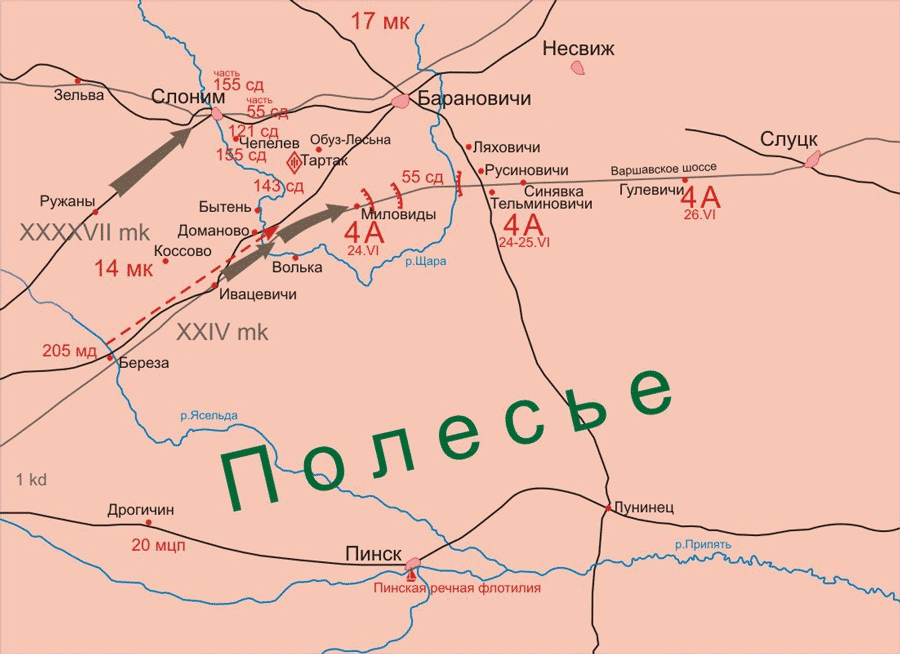
In my 1st chapter I cited the memoirs of V. E. Shomodi (in 1941 - commander of the 1st Battery of the 84th Artillery Regiment of the 55th Rifle Division, subsequently major general), on how on June 24 the forward units of the German 47th Motorized Corps attacked the Soviet troops in the area of Slonim. "At about 4 o'clock in the morning the main forces of the 155th Rifle Division were unexpectedly attacked on the flank by units of the 17th and 18th Tank Divisions of the 47th German Tank Corps; the division suffered heavy losses from the tanks and aviation of the enemy and began to retreat to the east…
In the situation that had developed the front headquarters ordered the 121st Rifle Division to stop its advance to the west and to organize the defense of the area of Slonim with the task of covering the Baranovichi direction and the unloading of the continuing to arrive units of its own and the 143rd Rifle Division, however, in view of the lack of time for organizing the defense, the division was unable to hold the western part of Slonim and by 9 o'clock in the morning took up the defense along the Shchara River in the area of the eastern part of the city.
The 155th Rifle Division with its main forces took up the defense along the Shchara River to the south - on the sector Chepelevo, Dobry Bor, and with part of its forces - north of the 121st Rifle Division.
The 143rd Rifle Division moved out a covering detachment to the line Dobry Bor, Govenovichi.
In this situation the 84th Light Artillery Regiment of the 55th Rifle Division named after K. E. Voroshilov, commanded by Major Ivan Kirillovich Voropayev…, was ordered to follow at an accelerated march from the area of Baranovichi, where it with the 107th Rifle Regiment of the division was at that time approaching, to Slonim and to support the battle of our troops on the line of the Shchara River.
At about 12 o'clock the regiment took up firing positions in the area of Albertin (east of Slonim) and began to carry out the assigned task.
In the period from 8 to 14 o'clock the tank divisions of the 47th Tank Corps of the enemy attacked our troops in the area of Slonim, however they did not achieve success: despite the fact that part of the forces of the 143rd, 155th and 121st Rifle Divisions had not occupied the defensive line in advance, they managed to gain a foothold on the line of the Shchara River in the area of Slonim and, having no unified control, each of them fought on its own, managed to stop the advance of the superior forces of the enemy, and the attacks in the first half of the day ended for it with losses in manpower and tanks…
At 14 o'clock after a powerful artillery and aviation raid the tank divisions of the 47th German Tank Corps, the offensive of which was directed personally by the commander of the 2nd Tank Group, General Guderian, began the attack on the 121st and 155th Rifle Divisions, but could not break their defense, and this forced him to bring into battle the second echelon of the corps - the 29th Motorized Division.
The 22nd Tank Division of Colonel I. V. Kononov, which came to the aid of our troops, and the detachment <of the 6th Rifle Division> of Colonel Ostashenko, which operated together with it, by an unexpected attack on the flank of the 47th German Tank Corps drew upon themselves considerable forces of the enemy and almost captured Guderian himself <this refers to the already described counterattack of the detachment of the 22nd Tank Division, which led to a crisis in the zone of the German 18th Tank Division>.
However, some subunits of the 18th Tank Division managed to break through to Obuz-Lesnaya, which created a threat of the enemy's seizure of the combat equipment and ammunition of the 143rd Rifle Division, unloaded at the Lesnaya station, and this forced part of the 143rd Rifle Division to withdraw from the line of the Shchara River to the area of the Lesnaya station.
By the end of June 24 the Germans had not managed to force the Shchara River near Slonim in the zone of the 155th and 121st Rifle Divisions. And southwest of Baranovichi in the area of the Lesnaya station the enemy received a fierce rebuff from the units of the 143rd Rifle Division that had unloaded here and stopped the offensive…"
Despite the bravura ending of this fragment of memoirs, the line of the Shchara River (very important from the point of view of halting the further advance of the German tank divisions on Baranovichi and, further, on Minsk) was by the end of June 24 overcome also by the 47th Motorized Corps on the Slonim (Baranovichi) direction: the withdrawal of the Soviet 143rd Division to the Lesnaya station is described.
But the exit of the main forces of the German 47th Motorized Corps (two tank divisions) to the area of Slonim meant also the beginning of the blocking of the Belostok grouping of the Red Army (the 10th Army and the greater part of the 3rd Army) already on June 24.
At the disposal of historians there are quite few documents of the Western Front concerning the first weeks of the war. The greater part of them passed strict censorship (practically all), and the Combat Journal of the Western Front is generally filled in after the fact. In this sense the protocols of the interrogation of General of the Army D. G. Pavlov are yet another source of information, despite the fact that the reliability of this information, of course, should also be called into question.
Here is a fragment of his interrogation, apparently relating to June 23: "The subsequent events developed in such a way that after our report to the Stavka about the difficult situation on the Brest direction and after the report that the mechanized units of the enemy are delivering a strong blow in the direction of Belsk to Gorodok <Grodok halfway between Belostok and Volkovysk>, apparently with the task of cutting off the units of the 10th Army, an order was received: to withdraw all units quickly to the line of the Shchara River. This order was handed to the 10th Army, twice transmitted by radio, the receipt was received, duplicated to all armies by aircraft and parachutists. Special delegates were sent to each army to control the execution of this order. These same groups of delegates were ordered to find in the area of the 10th Army Marshal of the Soviet Union Kulik. The units received the order and began to carry it out.
At the same time, to ensure the systematic withdrawal of the units to the line of the Shchara River, positions had already been prepared by me in full by the units of the 155th, 121st, 143rd Divisions, and they occupied this line".
And further: "I knew that on the 24th the units of the 3rd Army began the withdrawal to the line indicated by the Stavka - the Shchara River. I only did not know where the headquarters of the 10th Army was directing the 6th Mechanized Corps. According to my order it was to come out at an accelerated pace ahead of the infantry and to stand in the area of Slonim, in order to be ready to cut off a possible counterattack of the enemy with the aim of encircling the 10th Army from the southern direction. This order was transmitted by me to the Stavka and was approved".
A. Isaev in his book described a completely different situation: "The chief of the operational department of the 10th Army, Colonel Markushevich, subsequently wrote: "There was no order from the commander of the Western Front about the withdrawal from the line of the Bobr River, the Narew River. This withdrawal was carried out by the decision of the Army Commander-10. The order was issued at 14.00-15.00 on 25.06.41". The order of Golubev envisaged a withdrawal to the line of the Sokolka River. The chief of staff of the 10th Army, Major General Lyapin, subsequently confirmed these words of Colonel Markushevich".
And here is what order the front commander D. G. Pavlov, according to the documents of the Western Front, gave at 15.40 on June 25: "To the 3rd and 10th Armies. To the commander of the 6th Mechanized Corps. Immediately break off the battle and by forced march, moving by night and day, concentrate at Slonim. Contact by radio with Golubev (commander of the 10th Army) and directly with me. Report the beginning of the movement, in the morning of the 26th and the end of the march. Radio the state of fuel and ammunition".
Let us continue citing the interrogation of D. G. Pavlov: "On the 25th the front headquarters received a telegram from the headquarters of the 10th Army: "The units have come out to the Zelvyanka River, all the crossings are occupied by the enemy, I request support from the side of Baranovichi".
I ordered the 10th Army to take the crossings or to look for ways of withdrawal across the Neman River or further south through the forest massifs - according to the situation. The troops were ordered to give more precisely their location and to indicate the method of action. At the same time, for the correct actions of the group of troops already on the line of the Shchara River, my assistant for military educational institutions Khabarov was sent to the headquarters of Petrov <the 17th Mechanized Corps> with a group of parallel delegates, who were obliged to head the assistance of this grouping in the withdrawal of the units of the 10th Army, and then they were instructed where to come out with these groupings, in what direction.
By this time by successful battles in the area of Slonim the forward tank units of the enemy were defeated and a map was taken from a killed officer, in which the entire advancing grouping of the enemy was precisely indicated, from the Bug River to Baranovichi inclusive. From this map it is evident that the enemy conducted the offensive with the forces of three mechanized corps and that in the direction of the blow this entire group fell only on the front of first 2 rifle divisions, and then 1 (one) rifle division.
Judging by the course of events, it was possible to determine that in the area of Slonim and in the area of Volkovysk, apparently, a mechanized division of the left-flank corps of the enemy was thrown".
Finally, in the report of the headquarters of the Western Front of June 27 as of 20.00 it was said: "6th Mechanized Corps - the 4th Tank Division by 18.00 on 24.6.41 concentrated in the area of Lebezhany, Novaya Mysh (northwest of Baranovichi), having losses of up to 20-26%, mainly at the expense of small tanks; KV tanks do not always suffer losses, even from direct hits of bombs. The 7th Tank Division was on the march between Volkovysk and Baranovichi, conducting battle with its rearguards west of Volkovysk. The 13th Mechanized Corps on 24.6.41 with its remnants (individual men and machines) concentrated in the area of Stolbtsy, Baranovichi…"
I wrote in 2011 that the date June 24 in this document could in no way correspond to reality, and considering that in everything else the document speaks of June 26, there is a clear error. - I turned out to be wrong.
M. Solonin sharply changed the approach to this episode, having found in the archive the handwritten document on the basis of which this report was written:
"By the data collected by the delegates of the front headquarters it is established:
1. On 25.6 Baranovichi was in our hands. The 17th Mechanized Corps by organized defense put out of action by artillery fire up to 40 tanks of the enemy and continues to hold its positions.
2. The 4th Tank Division on 24.6 at 17-18 o'clock was in the area of Lebezhany, Novaya Mysh* (the division was seen personally by the delegate); losses up to 20-25%, mainly light tanks, KV do not take even direct hits of bombs.
3. The 7th Tank Division was on the march between Volkovysk and Baranovichi, conducting battle with its rearguard west of Volkovysk.
4. The 13th Mechanized Corps on 24.6 with its remnants was gathering in the area of Stolbtsy, Baranovichi [illegible] individual men and machines.
5. On 24.6 at 23.00 in the area of Stolbtsy [are] the remnants of the motorcycle regiment of the 6th Mechanized Corps (suffered great losses in battle with an airborne landing [of the enemy] with forces up to 300 men, supported by a powerful air raid).
Delegates: military engineer 3rd rank S… [illegible] and quartermaster 3rd rank Sidorov reported: the 4th Tank Division on 24.6 at 14.00 set out from Slonim to Baranovichi…"
"Lebezhany, Novaya Mysh" near Baranovichi, "set out from Slonim to Baranovichi" for the 4th Tank Division, the march of the 7th Tank Division from Volkovysk to Baranovichi on June 24 - this is some kind of nonsense!
So what was the Soviet 6th Mechanized Corps doing on June 24: advancing on Grodno or retreating to Zelva?
The offensive of the Mechanized Cavalry Group (MCG) near Grodno on June 24-25 did take place, a couple of hundred Soviet tanks were near Grodno, and although "the 20th Army Corps was not burned to ashes" (this is how Field Marshal F. von Bock presented in his diaries the opinion about these battles of the chief of staff of Army Group "Center", Major General G. von Greiffenberg), nevertheless the 256th Infantry Division, for example, was able to return to active operations on the Eastern Front not soon, only in August 1941. At the same time thousands of tanks, including a large number of heavy and medium ones, against which the German troops had few means of counteraction, were indeed not recorded near Grodno.
However, there was also no Soviet 6th Mechanized Corps in the area of Slonim, and all the more so in the area of Baranovichi on June 24-25, and for the German 47th Motorized Corps hundreds of modern Soviet tanks did not become a problem. Apparently, the thousand tanks of the 6th Mechanized Corps "dissolved" precisely in the Belostok "bag".
The Soviet troops tried to break out of the "Belostok bag" to the east, and the line of the Zelvyanka River became for many an insurmountable obstacle. Let me repeat a phrase from the interrogation of General D. G. Pavlov: "On the 25th the front headquarters received a telegram from the headquarters of the 10th Army: The units have come out to the Zelvyanka River, all the crossings are occupied by the enemy, I request support from the side of Baranovichi".
F. Halder wrote in the morning of June 25 in his diary: "The attempts of the encircled enemy to break through its withdrawal route through Slonim to Minsk have caused an aggravation of the tactical situation in the area of Slonim (17th Tank Division)".
And in the evening of June 25: "The crisis in the area of Slonim has been liquidated. As a result of the arrival in the area of Slonim of the 29th Motorized Infantry Division, the 17th Tank Division was freed for its use in the offensive on Minsk".
From German documents there is a known attempt of several (!) Soviet heavy tanks to break through on June 25 through Slonim, how they caused a "commotion" in the ranks of the enemy, because the German anti-tank means (the 37-mm anti-tank gun and the 50-mm gun of the Pz.III tank) were powerless before them. But this was no more than an episode. The main events on this line took place after June 25.
M. Solonin proposed such a version of what happened to the 6th Mechanized Corps on June 24: "The corps disintegrated into several groups not connected with each other. The first consisted of the command and headquarters, which had taken refuge in a remote forest and had switched off radio communication. Another group without long hesitation rushed to the east and already in the evening of June 24 successfully ran to Novaya Mysh. But there were also those who with desperate persistence, without proper coordination of actions, without communication and interaction with their own artillery and infantry, attacked the Germans at Kuznitsa - it is not for nothing that in the German documents there appear records of 12 tank attacks of the enemy and two hundred knocked-out tanks. How many were there of whom? Judging by how many tanks the Germans noticed on the battlefield, how many of their soldiers they lost, how much time it took them to "grind down" the huge mechanized corps, every fourth, if not every fifth-sixth, went into battle".
The idea of "command hiding in the forests" does not seem correct to me. I see this problem differently.
The commanders of the Red Army were preparing for a different war, and the morning of June 22 and the beginning of the war became a shock for them. One thing - one's own offensive against Warsaw, for which everything was ready, everything was thought out, over which the Soviet General Staff headed by G. K. Zhukov had worked for many months from morning to night (and the chief of the operational department of the headquarters of the Western Front, Major General I. I. Semenov, from November 1940 to April 1941 was in Moscow and worked in the group of the General Staff on the drafting of the plan for the deployment of the troops of the district). Everything was thought out and calculated.
Another thing - the unexpected beginning of a military campaign, where "the blacks made the first move first". What are the intentions of the enemy, what are its offensive groupings? About this the Soviet command in the first days of the war had no idea and constantly made mistakes (and accordingly took erroneous decisions).
In these conditions to organize an offensive of 1000 tanks - this is the work of headquarters, this is time, these are new calculations… The organization of the rear, first of all. M. Solonin says a lot about the presence of shells and fuel depots in the ZapOVO - the figures are impressive, but this is "presence in general". But for someone to bring what is needed to where it is needed and at the right time - this is a separate profession.
The Red Army is not an army where initiative was welcomed (the mass repressions against the military did their work). In the order "Use the red packet" (that is: use the pre-war plans) - in it there is one mockery, but no practical sense: the "red packets" had no relation to repelling a sudden aggression. But how not to use it? The advance of the 30th Tank Division on June 22 led to a meeting engagement with the divisions of the German 47th Motorized Corps and the first defeat.
The counterattack by the forces of the 14th Mechanized Corps on June 23 on the basis of Directive No. 2 - the cause of yet another catastrophe (the enemy overcame the line of the Yaselda River).
The formation of the MCG headed by Lieutenant General I. V. Boldin with offensive tasks - this too, most likely, is "from a past life". And the order of the MCG to restore the situation in the area of Merkine - this is already Directive No. 3 (sent to the troops in the evening of June 22). The correspondence of this order to the situation - the same as that of the counterattack of the 14th Mechanized Corps on June 23 (on the basis of Directive No. 2 of the early morning of June 22).
All these are steps toward the catastrophe.
Foolish orders of the higher command invariably lead to the demoralization of subordinate commanders. And now in conditions of the loss of communication with the higher command, having "red packets" that do not correspond to the situation, being in a "hostile encirclement" (for the commanders of the Red Army and many others the territory of Western Belarus is essentially an occupied territory, in which they had established themselves since the autumn of 1939 and planned a further campaign to the west), in conditions when the Soviet party and other authorities began their exodus from the "occupied territories"… - the subordinates face an existential choice: how much are you "for the Motherland" and how much are you "for Stalin"…
The German translators who participated in the interrogations of Soviet commanders and soldiers drew attention to the fact that they in the interrogations were very pessimistic and critical of Stalin's power. However, in the letters which they had previously sent to their relatives, their mood was quite bravura.
When on June 23 the divisions of the 14th Mechanized Corps delivered a counterattack in the area of Brest, the 6th Mechanized Corps had not yet participated in the combat operations. Although the command of the Western Front sent it on the offensive to the south, to Bransk, but apparently the command of the 10th Army did not find a worthy enemy for its most powerful iron fist on the southern face of the Belostok salient.
The front commander D. G. Pavlov, dissatisfied with the actions of the commander of the 10th Army, Major General K. D. Golubev, on June 23 gave the order "On the restoration of order in the control of the troops of the army" (to this same episode belong the words of Pavlov at the interrogation that Golubev "did not let the mechanized corps go over to the offensive"):
"Why did the mechanized corps not advance, who is to blame, immediately activate the actions and do not panic, but command. One must strike the enemy in an organized way, and not run without control.
You must know every division, where it is, when, what it is doing and what results.
Why do you not give the task for the attack to the mechanized corps?
Find where the 49th and 113th Rifle Divisions are and bring them out <These divisions according to the pre-war Soviet plans were to pass into the subordination of the forming 13th Army, therefore the headquarters of the 10th and 4th Armies, knowing this, did not consider them fully their own; on the very first day of the war the 49th Division (formally of the 4th Army) was resubordinated to the headquarters of the 10th Army, which certainly had no time for this then; so it perished in the Belovezhskaya Pushcha>.
Correct your mistakes. Bring up shells and fuel. It is better to take food on the spot.
Remember, if you do not act actively - the Military Council will not tolerate it any longer".
On June 23 General of the Army D. G. Pavlov demanded to deliver a counterattack in the southern direction, on Belsk, Bransk. And on June 24 the 6th Mechanized Corps was to advance already on Grodno, in the northern direction. How did he imagine this? Is a mechanized corps a rapier with which one can fence so easily? Is this how the offensive of 1000 tanks is prepared?
We now know that some units of the 6th Mechanized Corps remained in the defense on the Narew River south of Belostok (the motorized rifle regiments of the tank divisions, as well as the artillery of the 4th Tank Division, the most immobile branch of the armed forces) - precisely on the southern face of the Belostok salient.
M. Solonin cited in his research the routes of the tank divisions of the 8th Mechanized Corps of the Southwestern Front in a similar situation: receiving contradictory orders to deliver a counterattack, they cut tangled loops. - We have no such data on the 4th and 7th Tank Divisions of the 6th Mechanized Corps, but it is quite possible that on the Western Front there was something similar.
After June 23, when "Golubev did not let the mechanized corps go over to the offensive" (this is exactly what the front commander D. G. Pavlov reproached him for), and the divisions were taking up their starting positions for the offensive - the night passed "in reflection" for many commanders. And when on June 24 the main striking force of the Western Front - the MCG - prepared for the offensive, it already turned out to be not at all as it had been conceived.
Another unfavorable factor: the higher commanders poorly understood the logic of the use of the recently created mechanized corps (unlike the tank brigades, which already had combat experience). All the army commanders took away from their mechanized corps the motorized regiments of the tank divisions; in not a single battle did the motorcycle regiments play any significant role.
The mechanized corps of the Red Army of the 1940 model is a cumbersome structure, a "new-built" thing with unadjusted connections, with an unclear, untested practice of use, yet another victim of Stalin's gigantomania.
And most importantly: there were no people who knew how to use it.
General of the Army D. G. Pavlov complained how the control of an entire front was beyond his strength; Major General A. A. Korobkov (commander of the 4th Army) likewise complained that he would command a corps, not an army!
The commanders of the tank brigades were made commanders of tank divisions - but no qualitative leap in their thinking, of course, occurred.
In this sense there was no 6th Mechanized Corps as a welded combat formation. As there were no other mechanized corps of the Western Front - they were never employed as integral formations.
In the end the tanks of the 6th Mechanized Corps indeed "dissolved" in the Belostok salient. How this looked - M. Solonin cited an extract from a German document (as if relating to June 25): "According to the report of the 7th AK <advanced to the east from the southern face of the Belostok salient>, the road Belostok, Volkovysk, there where it passes through the forest, is jammed with the wreckage of the defeated enemy. 139 guns (of which 60 heavy), 150 tanks (of which 30 super-heavy) were counted on a sector of the road 14 km long. The picture of the destroyed manpower is more terrible than at Dunkirk... According to the reports of the crews of the "Stukas" <Ju-87 dive bombers>, the road looks terrible. The Russians have indescribable losses..."
The commander of the 7th Tank Division of the 6th Mechanized Corps, Major General S. V. Borzilov, wrote in his report (about the concentration of the division for delivering a counterattack): "At 22.00 on June 22 the division received an order to move to the new area of concentration - the Valily station (east of Belostok) and the subsequent task: to destroy the tank division that had broken through into the area of Belostok. Carrying out the order, the division encountered on all roads congestion because of the disorderly retreat of the rear services of the army from Belostok".
The disorderly retreat of the rear services of the 10th Army from Belostok - already on June 23?
D. Egorov in his research described the line of the Zelvyanka River as the retreat route of the units of the 10th Army, also on June 23.
"...The enemy's aviation from the first hours of the war began the destruction of important highway-road bridges in the depth of the territory of Belarus. One of them was the wooden bridge over the left tributary of the Neman, the Zelvyanka, in the very small town of Zelva. With its destruction the strategic highway Belostok-Baranovichi-Minsk-Smolensk was torn. The rear units of the 10th Army and other military formations (the rear of the air force, builders, medics, etc.), the residual groups of combat subunits and crowds of refugees began to accumulate on the banks of the river. And the Luftwaffe with impunity brought terrible devastation into their ranks. Those who could, crossed by fording and swimming, but the swampy banks completely excluded the crossing of motor vehicles. A few hundred meters from the destroyed highway bridge there was a completely intact railway bridge. This was a single-track structure without a wooden deck and even without railings, only between the rails there was a pedestrian path of two boards. Nevertheless, over it to the eastern bank of the Zelvyanka the evacuation of both motor vehicles and people could still be organized. But the absence of order and unified command led to the fact that even with an intact crossing the movement to the east did not resume. Only the exit to Zelva of a column of vehicles with employees of the Belostok UNKGB and UNKVD corrected the situation. The chief of the UNKGB directorate, Major of State Security S. S. Belchenko, took upon himself the direction of the crossing and under the leadership of the "Dzerzhinsky men" order was gradually restored. The only hindrance was the abandoned train of freight cars (the locomotive crew had fled), in which, as it turned out, there were deported Poles from Belostok. From among those gathered at the bridge volunteers-locomotive drivers were called out, three responded in the uniform of the Red Army, a captain and two privates. They raised steam, and after some time the train with the unfortunate people went off in the direction of Baranovichi. After that an endless stream of vehicles and people went over the bridge. The enemy's aircraft did not drop bombs, but fired from machine guns and cannons mercilessly and soon the foot of the bridge was littered with the skeletons of motor vehicles and the bodies of the dead. Those who managed to cross were subjected to attacks already on the eastern bank. If during the jumps along the sleepers the vehicles broke their suspensions, they were also thrown down. S. S. Belchenko himself also lost his car on the bridge and transferred to the car of the chief of the regional NKVD directorate, Captain of State Security K. A. Fukin".
What does this fragment from the memoirs of the future KGB general Belchenko say?
Already on June 23 (!) we see the flight of the authorities of the regions they had "made happy" to the east. They are in the front ranks. And even "organize" the crossing. Over which they themselves cross and flee further.
Is this really June 23? Even if there was an error here with the dating of the episode, it cannot amount to more than one or two days. And the German troops occupied Belostok only on June 27.
There is a known letter of the secretary of the Brest regional committee of the CP(b)B M. N. Tupitsin to the Central Committee of the CP(b)B P. K. Ponomarenko and personally to I. V. Stalin of June 25: "As a consequence of such a state <before this the letter describes the consequences of the first crushing blow of the Wehrmacht> from the very first days of the military operations panic began in the units of the 4th Army. Caught by a sudden attack, the commanders lost their heads. One could observe such a picture when thousands of commanders (starting from majors and colonels and ending with junior commanders) and soldiers took to flight. It is dangerous that this panic and desertion do not stop until the last time, and the military leadership does not take decisive measures. The workers of the regional committee of the party together with a group of border guards tried to detain those fleeing from the front. On the highway near Ivantsevichi we temporarily managed to stop this shameful flight. But here it is necessary to take more serious and urgent measures of struggle on the part of the military command.
An outrageous fact is also that the headquarters [of the 28th] corps did not establish communication with the regional committee, left for the command post outside the city [Brest], having lost communication with its units. Thus, many commanders and political workers instead of organizing the evacuation fled from the city in panic, first of all saving their families, and the Red Army soldiers fled in disorder.
The regional committee and the City Committee of the CP(b)B together with the regional directorates of the NKVD and NKGB tried at first to restore order in the city [Brest], but effectively could do nothing, since the Red Army units were retreating in panic. Therefore, not knowing the situation, not having communication with the military command, not counting on the combat capability of the military units, we were forced to leave the city of Brest.
The regional committee of the CP(b)B considers that it is necessary to take the most urgent and decisive measures to restore order in the 4th Army and to strengthen the leadership of the 4th Army".
Considering that there was a lot of Soviet authority in the territories they had "made happy" (at least the regional party and NKVD/GB chiefs from Belostok, Brest, Grodno and Baranovichi, and even more district ones), one can imagine the scale of the flight. Those who had arrived from the east (they were called "easterners") occupied leading positions in Western Belarus - nothing good awaited them…
And there was also the problem of the families of the command staff, who before the war were forbidden to evacuate, even when it already "smelled of gunpowder" in full. Not a few commanders in the critical moment were preoccupied with saving their families, and not with the control of their subunits.
The chief of the department of political propaganda of the 17th Mechanized Corps on June 24 reported to the front headquarters: "Through Baranovichi to the east in a continuous stream there are motor vehicles with servicemen, families, and also on foot both in groups and singly. And the appearance of the majority expresses a panicky mood. The measures taken - to organize the assembled command staff - did not yield a positive result. At night the majority of them fled. At the same time much of the command staff turns out to be without weapons... The railway administration and the commandant's offices have fled, the military commissariats and other institutions are leaving the city. The population flees from the city in crowds. The arriving command staff searches for the headquarters, about most of which there is no information.
In the Baranovichi hospital there is already a great overcrowding with the wounded, and there is no possibility to evacuate them to the rear of the country. The majority of the families of the command staff have been evacuated from Baranovichi, but still many continue to remain because of the absence of transport. Measures are being taken for their evacuation by motor transport…"
There is a known terrible episode of those days, when a Soviet anti-tank gun by mistake knocked out its own Soviet tank, in which, as it turned out, the family of one of the tank commanders was evacuating to the east 1 .
And there was also the problem of the recruits called up to the Red Army from the "western regions", who did not at all consider Soviet power their own and were not going to defend it at the cost of their lives.
By the way, the Germans in the first weeks of the war not infrequently released the newly called up local inhabitants into the Red Army; I have my own family story on this account.
…All these three factors - about the demoralization of the troops.
The key phrase that allows one to understand the handwritten document presented by M. Solonin, it seems to me, concerns the 13th Mechanized Corps: "The 13th Mechanized Corps on 24.6 with its remnants was gathering in the area of Stolbtsy, Baranovichi [illegible] individual men and machines".
From the memoirs of the chief of staff of the communications battalion of the 13th Mechanized Corps, Captain S. Z. Kremnev, it emerges (I cited them in my 1st chapter): "With the onset of dusk <June 24> we were ordered to withdraw to the line of the Zelvyanka River. The bridge on the road through the small town of Zelva had already been blown up, the houses in the small town were burning. We had to look for a crossing north of Zelva. In the area of the villages of Likhinichi and Samoylovichi on the swampy floodplain of the Zelvyanka some kind of crossing of wooden decking was discovered. We with the remnants of the vehicles forced it and moved on…"
That is, "individual men and machines" of the 13th Mechanized Corps on June 24 in the area of Stolbtsy and Baranovichi - this is possible. But the main combat units of the mechanized corps operated in these days in a completely different place.
After the line in the document of the Western Front "the 55th Rifle Division by the morning of June 24 in the area of Ruzhany" there is no longer any need to be surprised.
L. M. Sandalov described in his memoirs how the command of the Western Front was forced to collect information about the situation bit by bit (such a method, of course, could not give a complete picture of what was happening):
"Between 9 and 10 o'clock <June 25> Colonel Krivosheev returned to the command post of the army from the area of Slonim and reported the following:
- About two hours ago not far from Baranovichi I was stopped by three armored cars. From the middle one the front commander General Pavlov got out. Having questioned me about the state and position of the troops of the army, he put the data I reported on his map and in turn reported that to support the troops defending in the area of Slonim, from Stolbtsy a mechanized corps of General Nikitin <the 20th> was advancing. In addition he ordered me to convey to the army commander that troops from the internal districts were concentrating at the Dnieper. The Western Front must ensure their deployment. The task of the 4th Army, defending on the Shchara River, was to prepare defensive lines in the Slutsk fortified region and on the Sluch River. About the neighboring 10th Army Pavlov could say nothing".
In general the fragment of the interrogation of General of the Army D. G. Pavlov regarding the causes of the defeat of the troops of the Western Front makes the most sad impression: "The main cause of the rapid advance of the German troops into our territory was the clear superiority of the enemy's aviation and tanks. Besides this, on the left flank by Kuznetsov (the Baltic Military District) Lithuanian units were placed, which did not want to fight. After the first pressure on the left wing of the Balts the Lithuanian units shot their commanders and fled. This gave the German tank units the opportunity to deliver a blow to me from Vilnius. Along with this, the loss of control by the headquarters of the 4th Army by Korobkov and Sandalov over its units contributed to the rapid advance of the enemy in the Bobruisk direction, and the non-fulfillment of my order by the commander of the 10th Army, General Golubev, about delivering a blow on Bryansk by the 6th Mechanized Corps with the aim of defeating the enemy's mechanized grouping, after which to come into my disposal in the area of Volkovysk, deprived me of the opportunity to have a proper strike group".
Apparently, even in July 1941 D. G. Pavlov still believed that the main blow from the southern face of the Belostok salient the enemy delivered on Bryansk, Belsk and further on Grodok (halfway between Belostok and Volkovysk), and that a counterattack by the 6th Mechanized Corps precisely in that direction could have decided something cardinally.
Bransk and Belsk - this is 100-120 km west of Pruzhany and Ruzhany. That is, this is very far from the direction of the main blow of the German 2nd Tank Group.
(By the way, in the book "The Unknown 1941. The Halted Blitzkrieg" A. Isaev speaks of a map captured from a German officer of the headquarters of the 2nd Tank Group with the operational situation marked on it. On the map two offensive groupings were marked: on Slonim and on Slutsk, the 47th and 24th Army (Motorized) Corps, and also supposedly some 48th Tank Corps (48.Pz.K) operated in the area of Kleshchele - this is south of Belsk and Gajnowka. The figure 48 on the map is an obvious error, and A. Isaev suggested that this refers to the reserve 46th Motorized Corps. But this cannot be, the 46th Motorized Corps operated much further east, in June 1941 the mobile corps of the Wehrmacht were not yet called tank corps, and in the area of Kleshchele the 43rd Army Corps was advancing.)
Meanwhile the enemy quickly entrenched itself in the interfluve of the Shchara and Zelvyanka Rivers: already by the evening of June 25 the German 29th Motorized Division of the 47th Motorized Corps approached the area of Slonim. It advanced to the west along the Belostok-Slonim highway to Zelva and took under control the bridge in Zelva and the eastern bank of the Zelvyanka River, taking up a position "with a reversed front" to the west. Subunits of the division occupied Derechin and Golynki north of the highway, its headquarters was located in Ozernitsa (Yezerinitsa). After that two German tank divisions (the 17th and 18th) were able to focus their blow on Baranovichi.
It is very important to assess the dynamics of the buildup of forces on both sides (the pace): how the German command directed its forces to the area of Zelva and how the Soviet retreating units accumulated in the area of Zelva. There is insufficient information from the Soviet side. But as regards the German side it is known that the infantry divisions with all their forces tried to catch up with the 29th Motorized Division, however the nearest to the area of the battles, the 43rd Army Corps, advancing from the southern face of the Belostok salient through the Belovezhskaya Pushcha, did not manage to come to the aid of the 29th Motorized Division.
In connection with the significant advance of the tank divisions of the 2nd Tank Group to the east and the lagging behind of the infantry divisions, the commander of the 2nd Tank Group, Colonel General G. Guderian, moved forward, into the gap between the 24th and 47th Motorized Corps, his third motorized corps - the 46th Motorized Corps of General of Tank Troops G. von Fitinghoff (the 10th Tank Division and the motorized division of the SS "Das Reich"). On June 26 the forward units of the 10th Tank Division came out to the area of Tartak (southwest of Baranovichi), however instead of supporting the offensive of the 47th Motorized Corps on Baranovichi the 10th Division had to support with its tanks the 29th Motorized Division in the area of Zelva, Slonim. And the units of the SS division "Das Reich" that followed entered battle in the area of Ruzhany (Ruzhany had long been under German control, but was subjected to ever-increasing attacks of the Soviet troops retreating to the east).
On June 27 the German command sent to Zelva the 12th Army Corps (the 31st and 34th Infantry Divisions from the area of Brest), which also immediately came under the blow of the Soviet troops retreating from the southern face of the Belostok salient. (The 45th Infantry Division, which was subordinated to the headquarters of the 12th Corps on June 22, remained to storm the Brest Fortress.)
On June 28 the headquarters of the German 12th Army Corps took command over all the troops in the interfluve of the Shchara and Zelvyanka Rivers (besides the 31st and 34th Infantry Divisions, the 29th Motorized and 10th Tank Divisions were subordinated to it).
On the same day units of the German 9th Army Corps occupied Volkovysk, and almost captured the headquarters of the Soviet 10th Army, which hastily moved to the area of Derechin, and by the morning of June 29 broke through further east and located itself in Molchady northeast of Slonim (on the railway line Baranovichi-Lida; by this time both Lida and Baranovichi were already in German hands).
The settlement of Zelva (located on the western bank of the Zelvyanka River, that is, on the "Soviet" side) at that moment was overcrowded with Soviet troops. On June 29 the German 292nd Infantry Division of the 9th Army Corps came out to this area, but it did not dare to attack Zelva on the move and occupied it only on June 30.
On June 29, according to the War Diary of the chief of the German General Staff, Colonel General F. Halder, the battles on the line of the Zelvyanka River reached particular tension. The names of the settlements Derechin, Klepachi say much to those who are interested in military history. In those days in the area of Derechin the headquarters of two Soviet rifle corps were defeated: the 4th (of the 3rd Army) and the 5th (of the 10th Army).
For us it is important that on June 24 and 25 hundreds or at least dozens of Soviet heavy (KV) and medium (T-34) tanks of the 6th Mechanized Corps were not discovered in the area of Slonim. And in the battle for Baranovichi they were also not noticed.
In the orders of the headquarters of the Western Front and then in all military-historical studies the Soviet divisions in the area of Slonim and Baranovichi were called "the divisions of the 47th Rifle Corps". But the problem is that they precisely were not / did not become the divisions of the 47th Rifle Corps! The headquarters of the 47th Rifle Corps never arrived in the area of Slonim, Baranovichi.
According to the Collection of Combat Documents No. 35 (Western Front), the headquarters of the 47th Rifle Corps received an order to move to the west as early as June 21. But apparently it moved to the west already after the beginning of the war. Here is what was said in the Report on the actions of the administration of the 47th Corps from June 23 to July 3:
"On 23.6.41 the administration of the 47th Rifle Corps with the 273rd Separate Communications Battalion, the 462nd Corps Artillery Regiment, the school of the 246th Separate Sapper Battalion and the corps hospital loaded at the Berezina station.
Until 17.00 on 23.6.41 the 273rd Separate Communications Battalion, two battalions of the 462nd Corps Artillery Regiment from the Berezina station in three railway echelons proceeded in the direction of Minsk. At 21.00 on 23.6.41 the administration of the 47th Rifle Corps, the school of the 246th Separate Sapper Battalion and the corps hospital from the Berezina station set out in a railway echelon in the direction of Minsk and by the morning of 24.6.41 stopped at the Rudensk station (40 km southeast of Minsk), in view of the destruction of the Minsk railway junction.
On the night of June 24 to 25 by a personal trip from the Rudensk station to Minsk I received a personal order from the commander of the troops, General of the Army Pavlov - to contact the 4th Army in the area of Sinyavka (west of Slutsk) and to subordinate to myself the 121st, 143rd, 155th Rifle Divisions and the 17th Mechanized Corps.
On the basis of this order the railway echelon with the Administration of the 47th Rifle Corps, the school of the 246th Separate Sapper Battalion and the corps hospital was turned by me to Slutsk. In the first half of the day of 25.6.41 the railway echelon unloaded at the Slutsk station and concentrated in a garden 2.5 km northeast of Slutsk.
I personally appeared to the commander of the 4th Army at the command post in the area of Gulevichi, where I received the instruction of the commander of the 4th Army - to subordinate to myself the 121st, 143rd, 155th Rifle Divisions, retreating in the direction of Nesvizh (according to the information available at the headquarters of the 4th Army) <this was not happening on the front on June 25 in the area of Slonim, Baranovichi>, and the 210th Motorized Division.
On the basis of this instruction I decided to withdraw the command post of the headquarters of the 47th Rifle Corps onto the routes of the retreat of the divisions and at 24.00 on 25.6.41 concentrated in the forest in the area of Shishitsy (25 km north of Slutsk), where under my personal direction, at the head of a responsible group of commanders of the headquarters, I organized the search for the above divisions in the direction: Negoreloye, Stolbtsy, Mir, Novogrudok, Grozov, Kopyl, Nesvizh. The units of the divisions were not found in the indicated directions. In the area of Shishitsy I established communication with the commander of the 210th Motorized Division, which organically was part of the 20th Mechanized Corps and was carrying out its task.
On 26.6.41 after the occupation by the enemy of Slutsk communication with the 4th Army was lost.
I personally left for Minsk to establish communication with the front, but in Minsk there was no one - the front headquarters was already in Mogilev. Having become convinced that there were no units of the divisions on the presumed retreat routes, I decided: to go to join the 4th Army, which was retreating in the Bobruisk direction…"
L. M. Sandalov wrote about this regarding June 25: "At about 18 o'clock the commander of the 47th Rifle Corps, Major General S. I. Povetkin, arrived at the command post of the army from Bobruisk together with several workers of the corps administration. The army commander acquainted him with the situation and announced that the headquarters of the 47th Corps would have to unite the 143rd, 121st and 155th Rifle Divisions.
- Will you be able to head them near Baranovichi tomorrow morning? - asked the army commander of Povetkin.
He answered that until the arrival of the whole corps administration with the means of communication he considered it inexpedient to enter into command.
- By the morning of June 26, - Povetkin declared, - I will be able only to specify the location of the headquarters of the divisions.
General Korobkov did not object and let him go. At the same time he made a decision: with the onset of darkness to move the army headquarters closer to Slutsk…"
And here is what L. M. Sandalov wrote about June 26: "To organize the defense on the Berezina River I proposed to send to Bobruisk a group of commanders of the army administration. And although the commander agreed, it was not difficult to notice that he treated my proposal very coldly. Later I learned that as early as in the morning Korobkov had permitted the commander of the 47th Corps, General Povetkin, not to leave for the area of Baranovichi, but to return to Bobruisk and organize the defense there, using for this first of all his corps units".
Thus, the headquarters of the 47th Rifle Corps did not and could not engage in the organization of the defense of Baranovichi. To get from Bobruisk to Baranovichi by rail was possible either through the already mentioned Luninets (this possibility by June 25 had disappeared), or through Minsk, to which the corps echelons did not reach and stopped at the Rudensk station (as a result of massive raids of German aviation on the Minsk railway station). The branch Slutsk-Baranovichi in 1941 did not yet exist, there was only the branch Slutsk-Timkovichi in the Baranovichi direction; in 1941 it was planned to complete it, but as L. M. Sandalov wrote, by June 1, 1941 the branch from Timkovichi to Baranovichi was ready only to 80%. Maybe that is why the commander of the 4th Army A. A. Korobkov had other views on him.
And, apparently, it was then that the order of the commander of the 121st Rifle Division, Major General P. M. Zykov, of June 26, published by the modern researcher L. Lopukhovsky, appeared: "In view of the absence of centralized control of the 155th, 143rd and 121st RD and the garrison of the city of BARANOVICHI for the coordination of the actions of the indicated by the Stavka, from this date from 11:00 I have taken upon myself the temporary command with immediate report to the Military Council of the front…"
But that also did not happen.
In connection with the rapid advance of the enemy to the east on June 26 the headquarters of the Western Front left Minsk and moved to the forests east of Mogilev.
In the "Report on the actions of the 17th Mechanized Corps for the period from 22.6 to 1.8.41" it was said: "From the morning of 26.6 the assistant commander of the Western Front for military educational institutions, Major General Khabarov, entered into the command of the Baranovichi group of divisions…"
Thus in our study for the second time there appeared Major General I. N. Khabarov (the first time we mentioned him when he was sent in the evening of June 22 to the 4th Army with the "strictest order, if necessary, to shoot any number of people, but to stop the retreat of the 4th Army and to achieve that the army headquarters took control into its hands"). - A military leader born in 1888, in the 20s commanded a regiment, on the eve of the Soviet-Finnish war in September 1939 was appointed commander of the 8th Army, but already in December 1939 was removed from his post after the defeat of the troops entrusted to him in the area north of Lake Ladoga and transferred to rear positions. Nevertheless as a result of the attestation in April 1940 he received the rank of general and on June 22 met the war in the position of assistant commander of the ZapOVO for military educational institutions.
The list of the "Baranovichi group of divisions" is impressive: almost three whole rifle divisions (the 155th, 121st, 2/3 of the 143rd and 1/3 of the 55th Rifle Division) and two "non-tank" divisions of the 17th Mechanized Corps (about their combat capabilities later). But what does "Baranovichi group of divisions" mean: what kind of new formation / military association is this? What means of control were at the disposal of General Khabarov?
And at this time the German 47th Motorized Corps, having entrusted the dealing with the Soviet troops in the area of Slonim, Zelva to its 29th Motorized Division, resumed the offensive with two tank divisions on Baranovichi. To their aid from the south the 4th Tank Division of the 24th Motorized Corps turned on Baranovichi (it went "in single file" after the 3rd Tank Division, because the conditions of the terrain did not allow two tank divisions of the 24th Motorized Corps to move parallel to the Warsaw highway on the Slutsk direction).
The left-flank 143rd Rifle Division of the "Baranovichi group", as we remember, had no neighbor on the left (in that sector where the 55th Rifle Division did not reach), and it was precisely from the side of its unprotected left flank that the 4th Tank Division of the Wehrmacht came out to Baranovichi. Before this, from this direction on June 25 the reconnaissance battalion of the 3rd Tank Division attacked the Baranovichi airfield, but then its forces were enough only to undertake a diversion, but not to conduct a powerful attack.
L. M. Sandalov described the events of June 26 as follows: "In the area of Baranovichi the enemy somewhat pressed our rifle divisions, but also could not come close to the city. There the staunchness of our defense was to a considerable extent conditioned by the efficiency of General Khabarov, who had arrived near Baranovichi on the eve…"
However, three German tank divisions (the 17th, 18th and 4th), concentrated in one area - this is a very great deal. Even the arrival of a high Soviet commander with the broadest powers on the day of the most important events could little change anything fundamentally. On June 27 the combat group of Colonel G. Eberbach of the 4th Tank Division took Baranovichi. The battle for Baranovichi lasted a day.
In these battles the commander of the 143rd Division, Major General D. P. Safonov, was killed (by the way, in these same days the commander of the 55th Rifle Division, Colonel D. I. Ivanyuk, went missing).
It is important to remember that the task of the Soviet troops in the area of Baranovichi was not only to stop the enemy in his offensive on Baranovichi and, further, on Minsk - the task was the deblocking of the Belostok grouping, which was only just with the remnants of its striking power coming out to the Zelvyanka River.
After the abandonment of Baranovichi there was no longer any question of the deblocking of the Soviet troops of the Western Front that had fallen into encirclement.
Baranovichi - this is the deep rear of the Western Front, a regional center (in 1941) and a large railway junction, covered by a brigade air defense area (in Baranovichi itself was located the 518th Anti-Aircraft Artillery Regiment, with which an episode is connected, as if it "on the first day of the war, having fired all its ammunition, departed to the east"). There too, just before the war, the formation of the 60th Fighter Aviation Division had begun and there were subunits of the airfield service of the Air Force.
The main thing: in Baranovichi at the beginning of the war was located the headquarters of the Soviet 17th Mechanized Corps in the initial stage of formation. Its divisions were disposed: the 27th Tank Division - Novogrudok, the 36th Tank Division - Nesvizh, the 209th Motorized Division - Ivye. All these were fresh newly formed formations.
In the first days of the war the 209th Motorized Division of the corps, apparently, found itself in the subordination of the headquarters of the 3rd Army and occupied the positions of a blocking detachment on a wide front Lida, Slonim, without having contact with the enemy. And only on the night of June 25 to 26 it, by order, began its redeployment to the area of Mir north of Baranovichi.
Another event for the collection of conspiracy theorists: on June 23 the deputy commander of the 17th Mechanized Corps, Colonel N. V. Kozhokhin, shot himself. June 23 - had the catastrophe of the Western Front already become known by this day? Maybe something personal? A strange story.
The data on the armored vehicles of the 17th Mechanized Corps are presented in Table 8-3 (that is why I call these tank divisions "non-tank"). As regards its quantity there are disagreements. According to the report on the combat operations of the corps, 17 unserviceable BT-2 of the 27th TD were left at the place of disposition; this contradicts the table (either the BT-2 were a different quantity, or in the report the type of BT tanks that were unserviceable is incorrectly presented).
There is also a known handwritten note on the reverse of the report of the commander of the 209th MD, Colonel A. I. Muravyov, of the evening of June 25: "In Novogrudki 30 tanks have been left, fueled and camouflaged, guarded by no one. Much ammunition. The tanks in the 209th MD will also be used". This information about the tanks in Novogrudok (the place of disposition of the 27th Tank Division) also contradicts the data of the table.
| BT-2 | BT-5 | BT-7 | T-26 | KhT | ALL tanks | BA-20 | BA-10 | ALL armored cars | |
| 27th TD | 2 | 16/1 | 9 | - | - | 27/1 | 3 | 10 | 13 |
| 36th TD | - | - | - | 45 | 1 | 46 | 2 | 12 | 14 |
| 209th MD | - | - | - | - | 1 | 1 | - | 11 | 11 |
| ALL | 2 | 16/1 | 9 | 45 | 2 | 74/1 | 5 | 33 | 38 |
Through the slash the tanks under repair are indicated.
In the three divisions of the corps there were also 163 guns (including 37-mm anti-aircraft - 12, howitzers - 54) with 10 "Voroshilovets" prime movers and 5 "Kommunar" ones, 2 light armored "Komsomolets" ones and 31 tractors. How far the divisions of the corps could pull up their artillery from the places of disposition to the place of the battle - this, of course, is a question. Also important is the information that in the corps "up to 10,000 fighters were completely without weapons, even without rifles".
What do these unarmed "fighters" mean (a third of the authorized strength of a Soviet mechanized corps)? The notorious (first sung, then ridiculed) "one rifle for three" here finds direct documentary confirmation. But was there really a shortage of rifles in the Western Special Military District?
As in the case of the anti-aircraft artillery regiment, which on the first day of the war on June 22 "fired all its shells and departed to the east" - one can only shrug one's hands.
But if one thinks about what the 10 thousand unarmed "fighters" in a Soviet mechanized corps mean, one will have to recall that Baranovichi is the territory of Poland, seized in 1939, and by June 22, 1941 in the ranks of the Red Army in the ZapOVO there was a significant number of conscripts from the "new" territories who by no means burned with the desire to fight for the "Soviet Motherland".
By the way, in the memorial complex Katyn among the officers of the Polish army shot by the NKVD in 1940 there are quite a few surnames from Western Belarus (Grodno, Brest, Baranovichi).
And the theme of naming the just-forming formations "mechanized corps" - this is a theme of "socialist realism" in Stalin's USSR and in the Red Army in particular. It was not I who called them mechanized corps!
Thus, instead of a full-blooded mechanized corps in June 1941 in the area of Baranovichi there turned out to be a certain cadre formation (command staff almost without soldiers) with loud names "tank divisions", with a minimal number of obsolete tanks and with a large amount of artillery. M. Solonin emphasizes the anti-tank capabilities of these formations, but it is unclear to what extent their artillery was able to participate in the battles.
About the combat operations of the 17th Mechanized Corps it is known from a document which M. Solonin published in 2013:
"…In view of the fact that the rifle divisions operating in the area of Slonim began to retreat to Baranovichi, the corps commander gave the order: to turn the 27th and 36th TD on Baranovichi*. By 16.00 on June 25 the divisions began to approach Baranovichi and took up the defense from the south and southwest. The 71st Tank Regiment (36th TD) had the task of taking up the defense of the Baranovichi airfield, to destroy the enemy landing at the airfield <this refers to the "diversion" of the reconnaissance battalion of the German 3rd Tank Division> and to bring out the remaining material of aircraft there.
During 26.6 the enemy conducted intensified air reconnaissance of the areas of defense and bombing of these areas from the air. From the morning of 26.6 the assistant commander of the Western Front for military educational institutions, Major General Khabarov, entered into the command of the Baranovichi group of divisions. By the end of 26.6 Major General Khabarov made the decision to withdraw the 155th RD, 121st RD, 143rd RD to the line of the Usha River, and the 27th and 36th TD - to the area of m. Mir (18 km west of Stolbtsy). The withdrawal of the divisions began in the deep night of 27.6. Already during the withdrawal to Stolovichi (10 km from Baranovichi) the movement in the rear of the withdrawing units of tanks and motorcyclists of the enemy was established. With the onset of dawn the enemy's aviation appeared, which in interaction with the ground units dispersed the withdrawing units in different directions, partially destroying them…"
What happened? Why did everything happen so quickly? As was written in the documents of those days, the whole matter is in the "rapidity of the battles". All the advantage was on the side of the enemy: around Baranovichi at least three German tank divisions had gathered (on June 26 in the area of Tartak the 10th Tank Division of the 46th Motorized Corps also approached, but it had to turn to the west and come to the aid of the 29th Motorized Division in the area of Zelva); the command post of the commander of the 2nd Tank Group, Colonel General G. Guderian, also moved to the area of Tartak, which ensured firm leadership of the troops; moreover the enemy had a great advantage in mobility and could choose the direction of the application of further efforts, and besides it still had complete superiority in the air (which among other things meant air reconnaissance). As a result while the combat group of the 4th Tank Division captured Baranovichi by an attack from the south, the combat group of another, the 17th Tank Division, went around Baranovichi from the north and broke through to Stolbtsy, creating a threat of the complete encirclement of the Soviet troops in this area. The Soviet command had nothing to parry this lunge with.
And on the opposite side - units of four rifle divisions and two "non-tank" divisions without a single command. It is interesting why the defense of Baranovichi was not earlier entrusted to Major General M. P. Petrov and the headquarters of the 17th Mechanized Corps? Before the arrival of Major General I. N. Khabarov in the morning of June 26 there was no single command of the "Baranovichi group of divisions", and the defense of the important regional center turned out to be a complete improvisation. So it was impossible to inflict a defeat on the enemy.
At the same time the reserves of the Soviet command were already exhausted: the 209th Motorized Division of the 17th Mechanized Corps was only in the night of June 25/26 removed from its previous line Lida, Slonim, where it had no contact with the enemy and performed the role of a blocking detachment. It was sent to the area of Mir (west of Stolbtsy), but, apparently, its march did not have time to close the breach in the Soviet defense, it was defeated / dispersed, without inflicting any substantial damage on the enemy, and its commander, Colonel A. I. Muravyov, was killed (went missing).
At his interrogation General of the Army D. G. Pavlov highly assessed the actions of the 17th Mechanized Corps: "…in order to preserve the Baranovichi direction the 17th Mechanized Corps (without the material part) was ordered to ensure from the side of Obus-Lesna the Baranovichi junction, which was very conscientiously carried out by the 17th Corps even in conditions when it was completely surrounded".
But that was all…
After the occupation of Baranovichi the way for the German motorized mechanized formations to Minsk from the south was open, and the "Baranovichi group of divisions" found itself in encirclement.
Unlike the formations of the Belostok salient, the formations of the Baranovichi group managed to come out of the encirclement relatively in an organized manner, and in July 1941 on the "bones" / the preserved structure of the rifle divisions (the 121st, 143rd and 155th) they hastily added the "meat" of march battalions, and the 121st and 143rd Divisions even preserved themselves (their number) until the end of the war and were not disbanded (a unique result for the divisions of the 1st formation of the Western Front).
There remained one "strange theme" of those battles (in the battles of the first days of the war on the Western Front there turn out to be too many "strange" themes): the artillery captured by the enemy at the training ground in Obuz-Lesna.
25 km southwest of Baranovichi, in the area of the former tsarist military Sobolevsky camp (the area of Obuz-Lesna and Tartak), where the Soviet command on the eve of the war organized the military field administration of the Western Front, at the district training ground there turned out to be a huge number of artillery barrels which, as L. M. Sandalov recalled, fell to the enemy: "At the district artillery training ground in the area of the Reitanov station, southwest of Baranovichi <possibly an error: the Reitanov station is on a railway branch southeast of Baranovichi>, on the very first day of the war there turned out to be more than 480 guns of caliber 152 mm and higher. This was the material part of ten artillery regiments of the Reserve of the High Command located here at a camp assembly. Because of the absence of means of traction and the suddenness of the appearance of the enemy almost all this artillery was lost" (an article in the "Military-Historical Journal", 1971).
In his military-historical study L. M. Sandalov wrote about this regarding June 23: "The artillery regiments of the Reserve of the High Command being formed at the district artillery camp (west of Baranovichi), which had one prime mover per battalion, by the instruction received from the MFA of the front headquarters, transferred their guns in turn to the area of Slonim" <that is, to the west>.
In the book "June. 1941. A Programmed Defeat" (2010) L. Lopukhovsky and B. Kavalerchik gave the following explanation of the mystery of the huge number of barrels of heavy-caliber artillery captured by the enemy in the area of Baranovichi: we are talking about 45-mm anti-tank and 76-mm divisional guns intended for the armament of the tank regiments of the new forming mechanized corps (the 13th, 17th and 20th). According to the authors, at the training ground there could also be several tens of 152-mm guns transferred to specific regiments on the basis of which, according to the deployment scheme, new artillery units were to be formed.
I am not sure that this explanation is exhaustive.
A. Shirokorad in the book "Artillery in the Great Patriotic War" (2010) reports that "The Germans quite actively used captured ML-20s, which in the Wehrmacht received the name "gun-howitzer 15.2-cm KH.433/1(r)", while the 152-mm guns of the 1910/34 model they called "15.2-cm K.433/2(r)". How many captured ML-20s were used by the Germans in total, it was not possible to establish, but after heavy losses by March 1944 the Wehrmacht had in service 217 - 15.2-cm K.433/1. Since new captured shells from the end of 1942 arrived irregularly, in February 1943 the production of shells for the ML-20 began, and by May 1945 759.5 thousand of them had been produced".
Until now we know little about the forming regiments at the district training ground of the ZapOVO. In the area of Baranovichi the 301st HAR of the Reserve of the High Command met the war (it had in service 35 howitzers of 152 mm). It is described that it participated in the battle of June 27, managed to retreat to the east and in July 1941 participated in the battles as part of the 13th Army on the line of the Dnieper River.
In the combat report of the headquarters of the 13th Army as of 21:00 on June 28 it was indicated: "Along the sector of the army in a continuous stream there go people and even units. The 301st Howitzer Artillery Regiment with a limited amount of shells was stopped and brought into the combat order of the 108th Rifle Division… The 518th Anti-Aircraft Artillery Regiment passed through, which has new material, but not a single shell" <that same one, from Baranovichi>…
At the district training ground the 120th High-Power Howitzer Artillery Regiment of the Reserve of the High Command met the war with 203-mm English "Midvale" howitzers (4 battalions = 24 guns). The history of this regiment was studied in detail by L. Lopukhovsky (his father commanded this regiment, who perished in the Vyazma "cauldron"). Lopukhovsky wrote: "My father returned from the Crimean sanatorium early - on June 20. He could not miss the combat firing for the command staff of the newly forming units of the Reserve of the High Command of the district, scheduled for Monday. And he was going to leave for the training ground on Sunday, June 22. But on Saturday, June 21, he was reported that a train with 12 B-4 howitzers, which were intended for the regiment of the second priority, had arrived at the address of the regiment. And that they were being unloaded for transport to the "NZ" (reserve) warehouses. Another 6 such guns, delivered at night to the Kossovo-Poleskoye station, remained on the platforms". As L. Lopukhovsky wrote, the 203-mm B-4 howitzers of the 1931 model in all parameters surpassed the guns of the 120th HAR. A feature of the B-4 was the carriage with a tracked chassis, which provided the howitzer with a sufficiently high cross-country ability and firing from the ground without the use of special platforms and trails.
The new regiment (the 612th High-Power Howitzer Artillery Regiment of the Reserve of the High Command) was never formed, and, apparently, it was its huge howitzers that were captured by the enemy. And the 120th High-Power Howitzer Artillery Regiment itself with the beginning of the war moved out to Bereza-Kartuzskaya, from June 23 took part in the battles on the Slutsk direction and suffered heavy losses.
What other artillery regiments could be forming in the area of Baranovichi? As we have already mentioned, the 311th Gun Artillery Regiment of the Reserve of the High Command from its place of permanent deployment in Derechin departed for the district training ground Chervony Bor in the Belostok salient, leaving at the place of its former disposition 12 guns of 122 mm. According to the deployment plans on its basis the 611th Gun Artillery Regiment of the Reserve of the High Command was to be formed (in the 311th Gun Artillery Regiment there were 4 battalions, while usually a new artillery regiment was formed on the basis of the 4th battalion). But we know nothing about this.
On the basis of the 462nd Corps Artillery Regiment of the 47th Rifle Corps with the beginning of the mobilization the corps artillery regiment of the second priority - the 420th - was to be formed. The 462nd Corps Artillery Regiment, as we know, did not reach Baranovichi and later fought as part of the 4th Army in the area of Bobruisk, while the 420th Corps Artillery Regiment was formed, but for a long time fought with only one battalion. It is not excluded that the guns intended for it (precisely 152-mm) were located in the area of Baranovichi.
And on the whole the information about 10 new artillery regiments of the Reserve of the High Command does not contradict what we know about June 1941: Stalin's gigantomania is known, it is known that masses of new military equipment were driven by echelons from the factories to the border military districts, and that much of such equipment was captured by the enemy right on the railway platforms or in the NZ warehouses.
N. D. Yakovlev (in 1941 - colonel general of artillery, on June 22, 1941 assumed the post of chief of the Main Artillery Directorate, replacing Marshal G. I. Kulik; from 1944 - marshal of artillery) wrote in his memoirs: "The most major measure of which I am proud to this day was the categorical instruction of the Stavka adopted on my recommendation on the withdrawal of all artillery of high and special power to the rear. And the withdrawal immediate, without references to the most difficult situation of the first days of the war.
Of course, going to the Stavka with such a proposal, I perfectly understood how this order would be received in the fighting troops. But there was simply no other way out. It was necessary to take into account the limited mobility of the heavy and expensive guns of high and special power. And the tank and motorized mechanized formations of the enemy at the very beginning of the war sometimes in a single day covered up to a hundred kilometers into the depth of our territory!
Therefore, however much our glorious artillerymen, who thirsted to bring down their heavy shells on the enemy, were indignant, they still had to load into echelons and take the guns to the east, sometimes together with the evacuating civilian population.
Yes, during the forced withdrawal, and also during the defensive battles of 1941, we preserved this artillery. All the guns of caliber 203 and 280 mm, as well as the 152-mm long-range guns (only a few were lost) with the cadre personnel in time found themselves in the deep rear, where their crews continued their combat training. Until the time. For we knew that the time would come, would certainly come, when the artillery of high and special power would again take its place in the combat orders of our troops, who had already turned to the west, and would pave the way for them with mighty fire".
Obviously, it was not quite so.
In any case the catastrophe of the Western Front in June 1941 included the almost complete loss of artillery, the greater part - in the Belostok salient, from where it could not be withdrawn (heavy guns through a series of small swampy rivers: the Svisloch, Ros, Zelvyanka and Shchara - under the blows of aviation and without anti-aircraft cover, it turned out to be unrealistic to bring out to the east), and now also at the Obuz-Lesna training ground.
On July 11 in the summary of the German High Command the results of the battles of Army Group "Center" were summed up: in the Belostok-Minsk battle 328,898 people were taken prisoner, including several major generals, 3332 tanks, 1809 guns and other numerous military trophies were captured.
Insane figures both of prisoners and of captured "iron".
As of June 22 the main forces of the Soviet Western Special Military District (ZapOVO) / Western Front were concentrated in the Belostok salient, and in its westernmost part (the headquarters of all five corps of the 10th Army were disposed west of the meridian of the city of Belostok). And the key to the encirclement of the Belostok grouping of the Red Army by the enemy was in the area of Slonim, Zelva.
After the beginning of the war the breakthrough of the German motorized mechanized formations to Slonim and the occupation of positions on the Zelvyanka River with the front to the west meant the blocking of the main forces of the Western Front in the Belostok salient - this began in the morning of June 24 and was completed by the end of June 25. It is clear, blitzkrieg, supremacy in the air, Guderian (personally!), the disruption of communication and the violation of control in the Soviet troops… But on the third day?!!
It is precisely this date, June 24, that is stunning: the Soviet command had only just formed the Mechanized Cavalry Group from the striking forces of the Western Front and sent its main trump card, the 6th Mechanized Corps with a thousand tanks, to Grodno, in order to deliver a blow to the flank of the German advancing grouping from the Suwalki salient and to stabilize the situation up to Merkine (this is in Lithuania) - and the fate of the battle had already been fundamentally decided. And even the problem of the pace of the buildup of forces in the area of Zelva, Slonim on June 25-29 the enemy solved more successfully than the Soviet command.
Until writing this chapter I did not understand how fateful for the Soviet troops in the Belostok salient was the hasty, not corresponding to the situation counterattack of the formations of the 14th Mechanized Corps in the area of Brest on June 23. This action turned out to be in the shadow of the counterattack of the 6th Mechanized Corps near Grodno - there a thousand tanks (a thousand! the figure still fascinates!), while here in the zone of the Soviet 4th Army - some under-"mechanized corps" with not the most modern tanks.
But the needle of Koschei was not near Grodno, but in the area of Slonim, Zelva. The only line on which the enemy could be delayed - this is the line of the Yaselda River; the line of the Shchara River has a relation to the halting of the enemy's offensive on Baranovichi and, further, on Minsk, but not to the encirclement of the Soviet Belostok grouping. The fate of the strategically important area of Slonim, Zelva was decided precisely on the Yaselda. But this most important from the strategic point of view Slonim direction, as we have seen, was not included in the zone of responsibility of the 4th Army, it was transferred to it only on June 24, when everything had already been fundamentally decided.
It was precisely the absence of a previously prepared defensive line on the Yaselda River, the absence of plans for the defense of this line, that played the main role in the defeat. And the Soviet units that could have stopped the enemy on this line were wasted in the hasty poorly prepared counterattacks of June 23.
What would the "northern pincer" of the Wehrmacht in the zone of Army Group "Center" (the breakthrough of the 3rd Tank Group through Vilnius to Minsk) have been worth without the breakthrough of the 2nd Tank Group to Slonim, Baranovichi?!
We have examined step by step what happened in the zone of the 4th Army in the first days of the war. And now the question arises: how did the Soviet leadership plan to defend itself in the event of an attack by Germany? Was it preparing for such a beginning of the war? In other words: where are the defense plans? This question has become a sore subject, the official historians simply omit it as unimportant. "What difference does it make how the chess pieces are initially placed on the chessboard?" - that is the whole answer-analogy.
In the document "Cover Plan of the Western Special Military District. [June 1941] // TsAMO RF. F. 16. Op. 2951. D. 243. L. 4-34", published in the collection "The Declassified Summer of 1941" (2011), it was said about the plan in case of a breakthrough of large motorized mechanized forces of the enemy from the front Biala-Podlyaska, Pishchats in the direction of Brest, Baranovichi: "The 47th Rifle Corps in interaction with the 10th Mixed Aviation Division, firmly occupying the line Pruzhany, Gorodets <east of Kobrin on the Pinsk direction>, destroys it and does not allow its spread east of the indicated line.
The 14th Mechanized Corps, having concentrated in the anti-tank area and behind the cut-off position in the area of Kamenets-Litovsk, Shereshevo, Dzyaduvka, attacks the enemy on the flank and rear in the general direction of Zhabinka and together with the units of the 47th Rifle Corps destroys it.
The 17th Mechanized Corps, remaining in the reserve of the district, is transferred to the area of Pruzhany in readiness to reinforce the blow of the 14th Mechanized Corps or the 47th Rifle Corps".
Now, knowing where the 47th Rifle Corps actually was and what it was doing, and also knowing how mobile the 17th Mechanized Corps was in the stage of formation, one can ask the question: what relation does this "plan" have to reality? What kind of document has been slipped to us?
The talk about the presence of cover plans ("Grodno-41", "Kobrin-41") in the Soviet command breaks against the simple fact that not a single "red packet" corresponded to the circumstances of a sudden attack by Germany.
In the same way the withdrawal of the Military Field Administration of the Western Front to the area of Baranovichi before the war did not correspond to the circumstances, and it had to be folded up already on the second day of the war.
In Soviet times it was said that "Stalin did not believe in an attack by Germany" and "was not preparing for war". Now this argument no longer works: it has been proven that the preparation for war was going on, the scale of this preparation is impressive, therefore a new argument has appeared: "the enemy simply forestalled us in deployment". It is bad not only because it is a "new-built thing". There is a more important objection to it: so you assert that to prevent defeat one needed to forestall the enemy in deployment oneself? To attack first? Then you have no disagreement with V. Suvorov! But this still does not reject the necessity of being prepared for a sudden attack. And otherwise why was there no place for all these carefully worked out "red packets" in the first days of the war?
Among other things, the distribution of modern tanks in the formations of the ZapOVO speaks for itself: at the tip of the offensive (in the very center of the Belostok salient) was the 6th Mechanized Corps with a thousand tanks and the highest in the ZapOVO number of modern tanks (KV and T-34), modern medium and heavy tanks, albeit in minimal quantity, were even in the composition of the 11th near Grodno and the 13th on the southern face of the Belostok salient mechanized corps. And there where G. K. Zhukov (according to his "Reminiscences and Reflections"; lies, of course) expected the main blow of the enemy - "on Baranovichi" (during the strategic game in the beginning of 1941) - only light tanks of the 14th Mechanized Corps and, even worse, the 17th Mechanized Corps almost without tanks. G. Guderian described his first encounter with modern Soviet tanks only in the area of Borisov - and this is already the beginning of July and east of Minsk.
The defeat of the main forces of the Soviet Western Front by this time was drawing to a close.
In my chapter there is a large number of citations from the memoirs and the scientific research of L. M. Sandalov. He was much referred to by Viktor Suvorov (V. B. Rezun) in his first books. Not surprising: in fact L. M. Sandalov in his memoirs (of 1961) and in the military-historical research on the combat operations of the 4th Army in the first days of the war (which was hidden behind the classification "DSP", of the same time) said everything: there were no rear army (of the 4th Army) and front defensive zones, the army was preparing only for offensive operations and conducted only such exercises, there were no mines and barbed wire…
For his time his analytics was a feat. What did we not understand then?
We did not want to admit to ourselves… The tinsel of the slogans "Great Patriotic", "The Feat of the Soviet People" hindered… Until Viktor Suvorov made a "breakthrough in cognition"; he came to us already in the 90s. He was followed by Vladimir Beshanov (2000), Mark Solonin (2004)…
The theory of V. Suvorov that the Soviet leadership itself was preparing an attack on Germany frightened and caused active rejection (not by me). In essence, the whole Soviet version of the initial period of the Great Patriotic War was thrown onto the scrap heap! The multi-volume official histories (of the Second World War, the Great Patriotic War), the recognized masters V. Anfilov, M. Gareev, the "Reminiscences and Reflections" of G. K. Zhukov… - it turned out, all this is garbage.
In the period of writing my first version of the book about 1941 (in 2006) to admit to "Rezunism" was as good as death. My comrade D. Egorov struggled in every way with the theory of V. Suvorov, even when immersion in the events left no doubts… Through his generally excellent book there are scattered all sorts of inanities that have long been refuted: about gliders with landing troops and tankettes, about heavy German tanks near Grodno ("it cannot be that tanks in the Wehrmacht were only in tank divisions"). We argued with Dima, discussed this question with other interested researchers… In an attempt to explain the inexplicable we clutched at the most improbable fantasies and rumors of those times ("landing troops everywhere" and so on).
Much time has passed, the veil of the "anti-Rezunists" has dissipated. The official historians of the new call return to the formulas: "there was no flight", "they fought to the last drop of blood", "before the wise Joseph Vissarionovich there stood a difficult task", "they forestalled us in deployment"… Or here is another: "the Soviet divisions stretched out in a thread at the border" - where is "in a thread", if the greater part of the 4th Army was concentrated in the area of Brest, where it came under the first crushing blow?!
Interesting reading - the articles of the L. Lopukhovsky we have mentioned (a retired colonel) about how he already in "democratic" Russia (in the 2000s) struggled for access to archival documents of the Great Patriotic War and for his right to write about the war on the basis of these documents (he dealt with the theme of the Vyazma "cauldron", in which his father, the commander of the 120th High-Power Howitzer Artillery Regiment of the Reserve of the High Command, went missing). In its character the text of L. Lopukhovsky resembles the book of A. Solzhenitsyn "The Oak and the Calf". That is, the former "optimizers of military history" were replaced by new ones, but the principle remained the same: "We will not show you anything", THEREFORE "You will not prove anything".
Another Russian retired colonel, M. Khodarenok, also mentioned the difficulties of access to the archive to documents on painful themes (which include the initial period of the war) and also in the 2000s. He even directly hinted at the destruction by the Ministry of Defense of important archival files.
But we do not need many more words. A detailed history of the defeat of one Soviet 4th Army in the first days (on the very first day) of the war is enough.
1.
This episode is described in the book of E. Drig "Mechanized Corps in Battle" (2005), it is cited in his book by A. Shirokorad "Artillery in the Great Patriotic War" (2010): "At 11:00 on June 22, 1941, in the area of the small town of Tevli, the artillerymen of the 627th Howitzer Artillery Regiment of the 205th Motorized Division by a direct hit destroyed a suddenly appearing tank. As it turned out, it was a T-26, on which the family of the commander of one of the regiments of the 22nd Division was evacuating".
A similar episode is described in the memoirs of I. A. Tolkonyuk "Wounds Heal Slowly" (in 1941 - officer of the operational department of the headquarters of the 19th Army), only it happened already in the middle of July 1941 in the area of Vitebsk, and there the tank was not knocked out but stopped and returned to battle, and the wife of the junior commander was simply put out on the road. "What happened to her afterwards?" - asked Tolkonyuk…
⇑
Date of publication of this page in English - October 1, 2026
